
(no title)
brilliantcode | 8 years ago
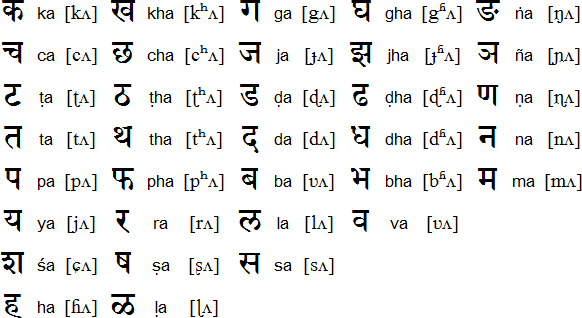
Taking a look at Sanskrit, it looks very cool. I think it's aesthetically better looking than Korean alphabet.
brilliantcode | 8 years ago
Taking a look at Sanskrit, it looks very cool. I think it's aesthetically better looking than Korean alphabet.
umanwizard|8 years ago
It's considered that by lay people, largely due to Korean patriotism, not by real linguists (can you provide a source?)
> an HN'er should be able to read and write Korean in about an hour.
So, you're talking about the alphabet used to write the language, not the language itself. At best you've proven that Korean has a highly regular writing system. But I'd argue that the average HNer could learn to read, for example, Spanish in about two minutes.
brilliantcode|8 years ago
I didn't say the MOST, it's among the more scientific languages. I'm not pushing for Korean patriotism, that's just your own assumptions.
> So, you're talking about the alphabet used to write the language, not the language itself. At best you've proven that Korean has a highly regular writing system. But I'd argue that the average HNer could learn to read, for example, Spanish in about two minutes.
Hangul is the writing system that is uniquely different from a latin based system like Spanish. Your argument is moot.
jdmichal|8 years ago
https://en.wikipedia.org/wiki/Orthographic_depth
kwillets|8 years ago
Unfortunately the people in charge of the Revised Romanization decided that these rules should be applied to the Roman alphabet as well, so we have execrable constructions like "Daegu" or "bibimbab" which can't be pronounced from English spelling rules.
Nadya|8 years ago
[0] http://www.ryanestrada.com/learntoreadkoreanin15minutes/
0xcafecafe|8 years ago
mrout|8 years ago
If you can't comprehend what you're reading, you're not reading. Learning the Korean alphabet is not learning Korean.
raingrove|8 years ago