
(no title)
ergothus | 5 years ago
Here's once quote: "Starting when computer technology first emerged during World War II and continuing into the 1960s, women made up most of the computing workforce. By 1970, however, women only accounted for 13.6% of bachelor's in computer science graduates. In 1984 that number rose to 37%, but it has since declined to 18% -- around the same time personal computers started showing up in homes. According to NPR, personal computers were marketed almost exclusively to men and families were more likely to buy computers for boys than girls." ( from https://www.computerscience.org/resources/women-in-computer-... )
Here's a graph of the data: https://images.techhive.com/images/idge/imported/article/ctw.... ( found via https://www.computerworld.com/article/2474991/women-computer... )
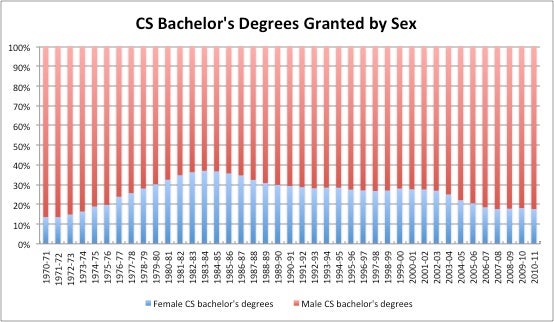
Those are only talking about successful degrees, there are plenty of more datapoints to look at when you consider entry vs completion, and similar stats from post-graduation careers. This doesn't prove causality, but their statement stands as viable.
XorNot|5 years ago
This is cherrypicking in the most bizarre way: if you can't explain the earlier oscillation, why should I accept the later oscillation? Which also doesn't line up with the type internet gaming which was exploited around the 2010s mark where alt-right groups began aggressively recruiting out of the gaming community via the "gamergate" movement.
In every case you're datapoints don't make any sense - there weren't 12 years olds playing Call Of Duty in 1985 and learning to scream racial and sexual epithets in voice chat. Games with a substantial violent component - the first person shooters - Wolfenstein 3D came out in 1992.
Which still doesn't actually explain anything, because it's not remotely clear how "shooting nazis" lines up with excluding women from CS.
ergothus|5 years ago
Clearly women in the 1970s had no other obstacles - they couldn't obtain credit(!), much less be on equal footing in so many other ways. The issue is not "but there is an earlier oscillation", it's "if women have been slowly moving in direction of equality, what reversed that?" or "If women were able to 'be interested' back then, how can we claim they aren't now"?