
(no title)
throwaway34241 | 4 years ago
I agree - I've always liked that story about the grocery store.
I don't think bad policies are something that can be straightforwardly extrapolated into a course to the Soviet Union though. The US has had price controls in the past but backed off. Even large welfare states like Sweden eventually hit a point where they stopped or turned back the expansion of the public sector (reducing marginal rates, eliminating wealth taxes, spending as % of GDP leveling off, etc).
The Soviet Union even collapsed while it was heading in a more positive direction from where they were at (reducing state political and economic control).
So there doesn't seem to me to be a straightforward connection between incremental policy changes and collapse.
I don't see a clear connection between collapse and subsequent "steering back" either. Support for the market economy and multiparty democracy in Russia are both at record lows [1]. Venezuela has undergone an economic collapse but is still very dysfunctional. Neither seems on track to catch up with western countries any time soon.
It's interesting to contrast this with China, which had similar issues to the Soviet Union (of having an inefficient state-run economy) and had heavy debate about how to go about reforming it [2]. At least for their economic prospects the incremental path they chose seems to be working out better.
[1] https://www.pewresearch.org/global/wp-content/uploads/sites/...
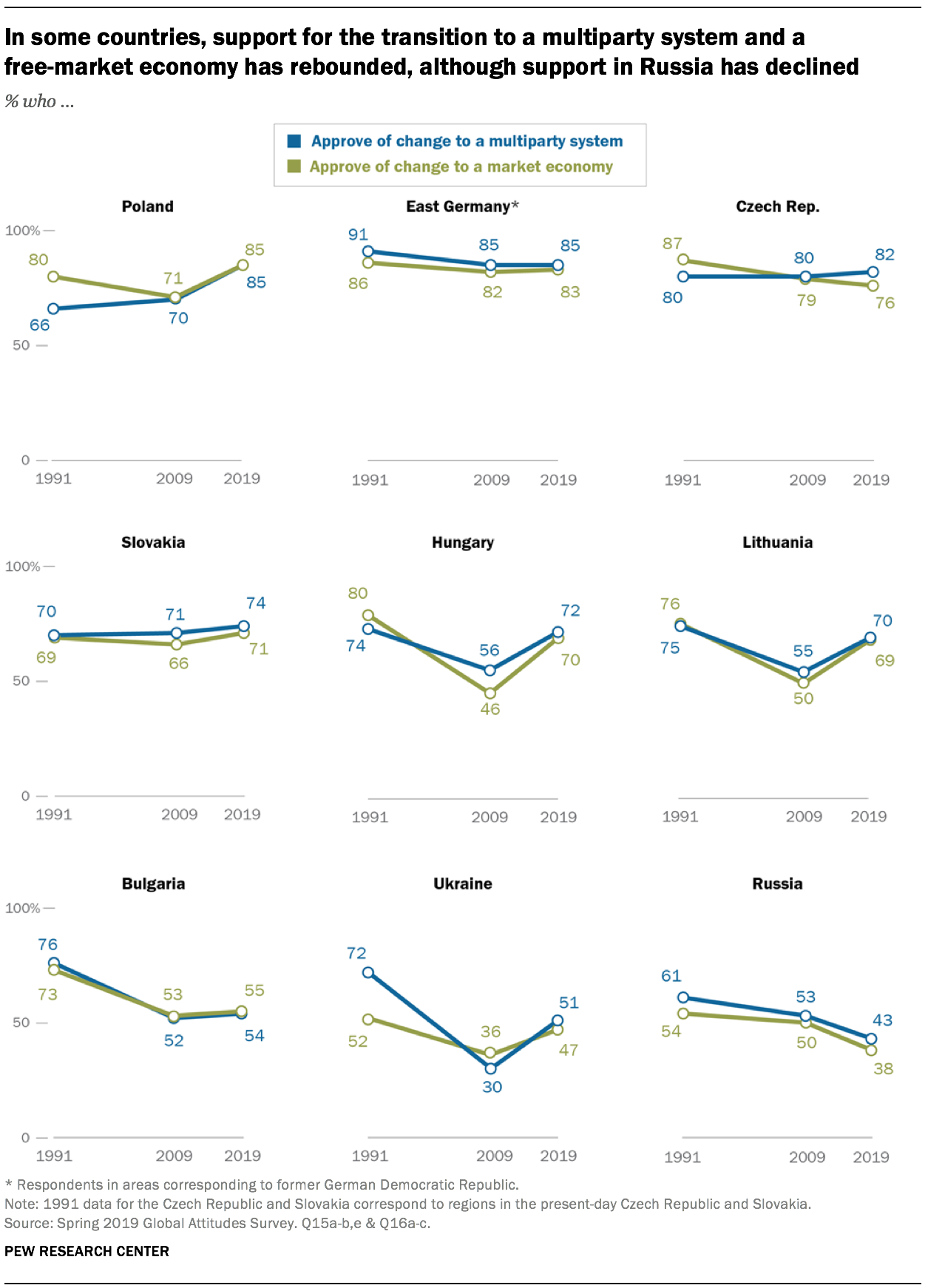
[2] https://www.amazon.com/Escaped-Therapy-Routledge-Studies-Chi...
angelzen|4 years ago
I have to say that my American friends have a much higher confidence in the pendulum theory. Coming of age near the end of a 40 (70?) year historical tailspin, I have a somewhat less optimistic view.
throwaway34241|4 years ago
But the political coalitions here (and even the economics) are somewhat complicated. For example, California recently passed several bills to de-regulate housing, which were initiatives of (a sub-faction of) the left-leaning party that controls the state. And the right-leaning party is not a technocratic one like Singapore - an important sub-faction of the right-leaning party goes against advice by economists themselves, on macro issues and increasingly on trade also.
The non-economic factions are more poised to benefit from dysfunction, and in my view, also more likely to cause dysfunction, and so enable each other. So my view is also more similar to a tailspin than a pendulum. Just that it is not as simple as trying as hard as possible to displace the establishment, because the people best positioned to replace them are often worse.
There is another, darker, argument, which I've seen presented by some fairly well-informed people. It goes something like this: the industrial revolution, with its huge inequality, financial crash, and the eventual fall to authoritarianism around the world, is, in fact, the natural order of things. And this has been papered over by massive economic distortions by governments starting with WWII, along with perpetually increasing debt levels as interest rates decline (which since debt and savings are two sides of the same coin, allows overall savings to increase and makes things less zero-sum).
With this premise, there is no natural politically-stable state to return to, and the path for managing outcomes that maintain public support for capitalism becomes even more narrow. I'm still thinking about it, but (unfortunately) I've found the arguments pretty compelling (from billionaire capitalist Ray Dalio [1], among others).
[1] https://economicprinciples.org/