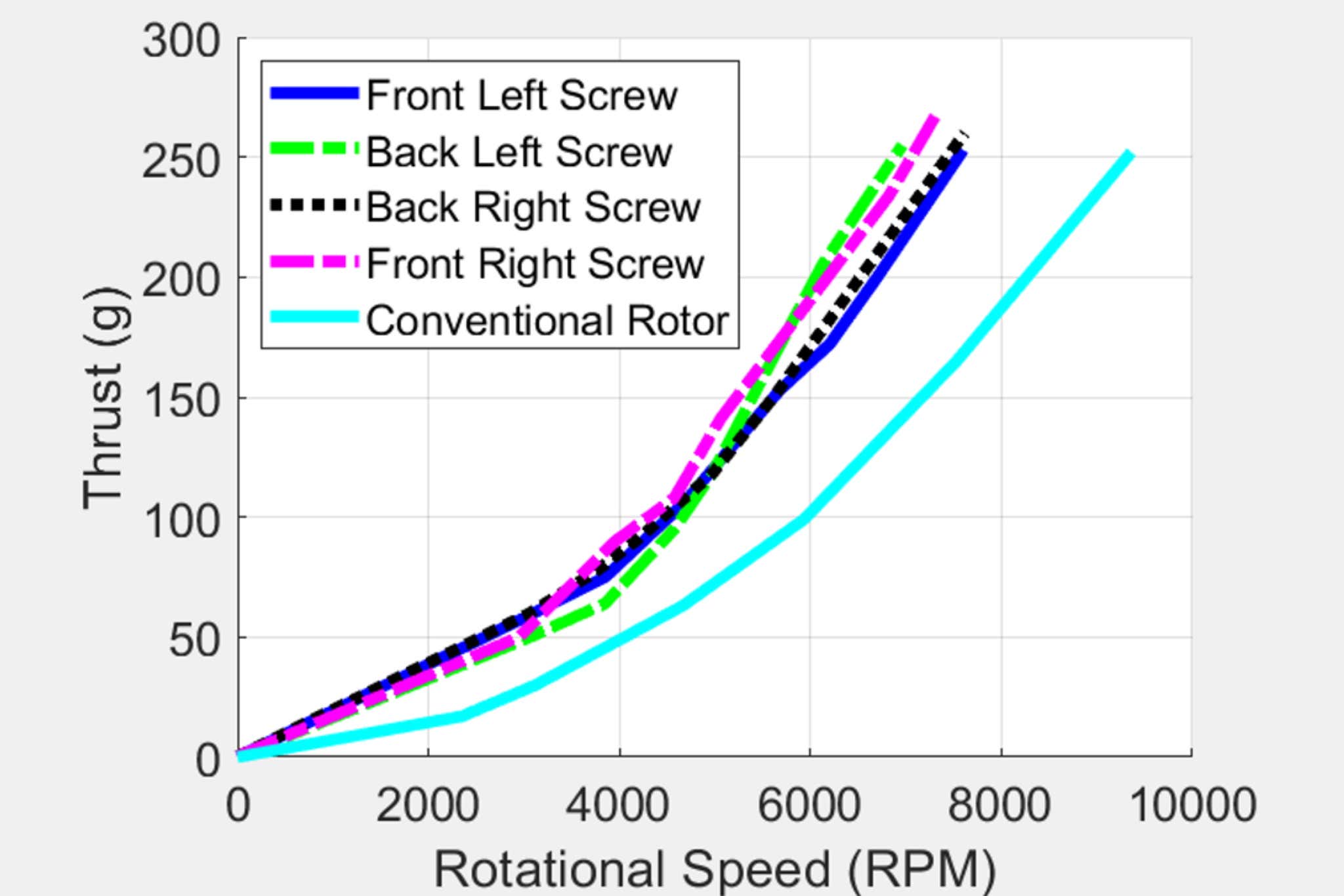
Although a better metric might be to look at the thrust to motor power and get an idea of its efficiency relative to traditional rotors. I can put larger blades on the motor and will get more thrust at the same RPM but the motors will have to work harder to push those blades.
Indeed, the screw shape is essentially a large number of rotor blades, welded leading edge to trailing edge. Undoubtedly it produces more thrust for a given RPM, and undoubtedly the efficiency is horrifically bad.

dr_orpheus|4 years ago
dTal|4 years ago
whiddershins|4 years ago
Also seems like the screw shape could be less prone to breakage.
unknown|4 years ago
[deleted]
walrus01|4 years ago
see users guide here for details.
https://www.tytorobotics.com/products/thrust-stand-series-15...
it's basically a load cell and an inline DC ammeter with some logging software.
usually denoted as g/w or kg/w on big things.