
top | item 32063180

(no title)

Temporal_Trout | 3 years ago

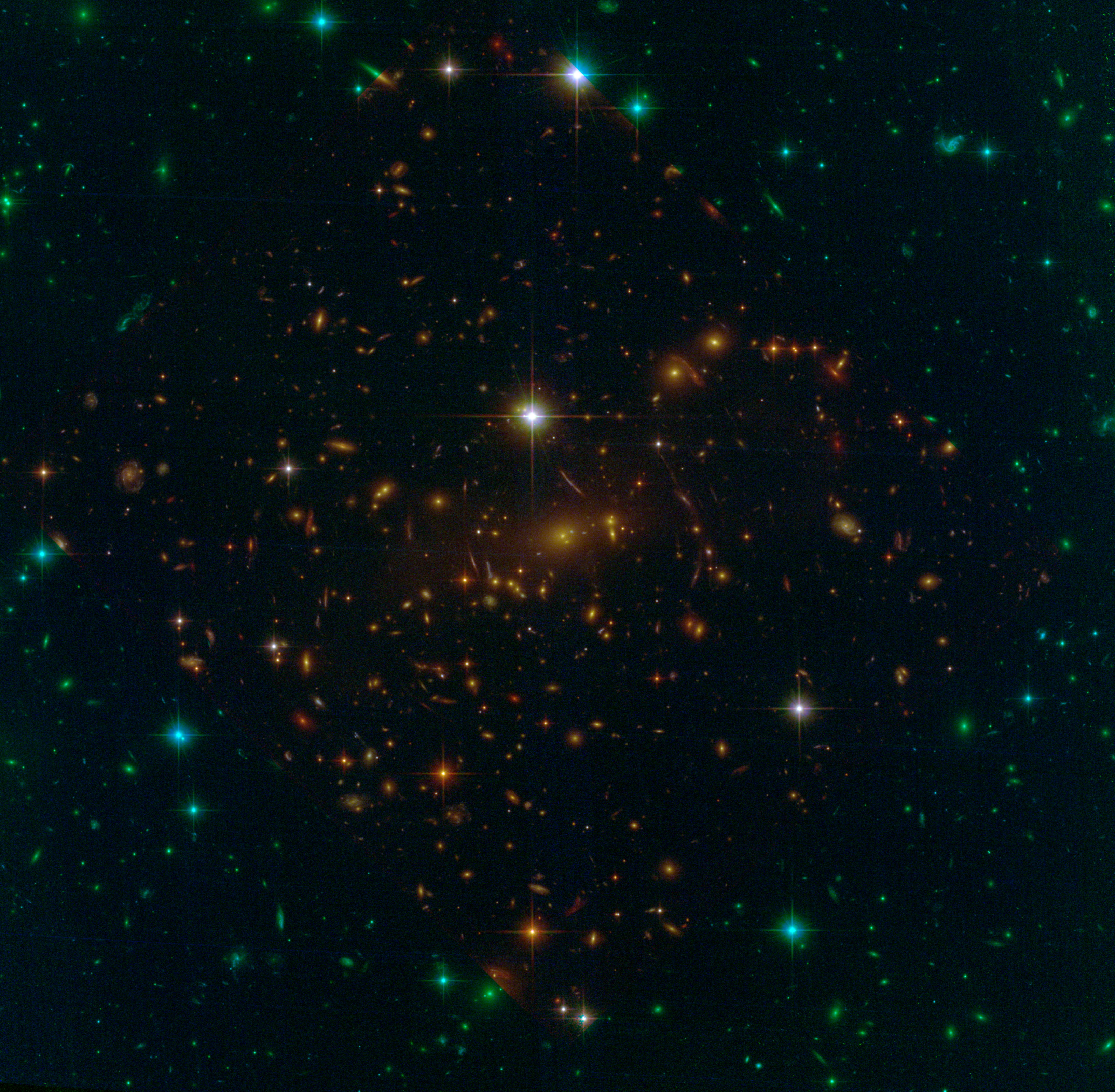
Higher Resolution Images available here: https://webbtelescope.org/contents/media/images/2022/038/01G...

Full-Res 4537x4630 PNG (28.51 MB): https://stsci-opo.org/STScI-01G7JJADTH90FR98AKKJFKSS0B.png

Hubble's capture of the same area: https://bigthink.com/wp-content/uploads/2022/07/smacs0723-73... and a gif comparison vs the JWST: https://i.redd.it/9uyhwijeo0b91.gif posted by /u/WhatEvery1sThinking on Reddit.
discuss

order

wolfd|3 years ago

Thanks for finding those images! I threw together a page that lets you compare them via a slider. You should be able to zoom in on mobile!

https://blog.wolfd.me/hubble-jwst/

The .gif comparison was a bit... upsetting since the color palettes are so limited and the resolution is so low, so it really didn't put JWST _or_ Hubble in a good light.

caseyf7|3 years ago

This is incredibly useful. Thank you!

fsckboy|3 years ago

would it make sense to balance the two images in terms of brightness? the hubble one just seems dimmer.

There is some extra "pinpoint" clarity in the Webb image, but it doesn't show (for instance) a bunch of new stuff, I was surprised at that.

HPsquared|3 years ago

It looks like restoration of an old painting where the aged, yellowed varnish is stripped away to reveal the (much brighter and more detailed) original painting below.

skrause|3 years ago

All the very red galaxies in the JWST image are mostly or completely invisible in the Hubble image. That’s because they’re so redshifted that they’re out of the spectrum Hubble can see. Those are the galaxies that are really far away.

perihelions|3 years ago

Here's a variant of that GIF that separates out the blue, blue+green, and blue+green+red channels, to (hopefully) highlight which differences are due to the longer wavelengths (and which look more like exposure time difference). Webb's color mapping roughly aligns with the RGB channels, so I think this is meaningful [0].

https://i.ibb.co/D8dW6v5/jwst.webp

[0] https://webbtelescope.org/contents/media/images/2022/038/01G...

("...the assigned colors are: Red: F444W Orange: F356W Green: F200W + F277W Blue: F090W + F150W")

Steps to reproduce:

    convert 9uyhwijeo0b91.gif[1] -resize 4537x4630 aligned-hst.png
    cp STScI-01G7JJADTH90FR98AKKJFKSS0B.png jwst-rgb.png
    convert jwst-rgb.png -channel R -fx "u*0" jwst-gb.png
    convert jwst-gb.png -channel G -fx "u*0" jwst-b.png
    convert -delay 150 -loop 0 jwst-{b,gb,rgb}.png aligned-hst.png my.gif
    ffmpeg -i my.gif -loop 0 my.webp

ffhhj|3 years ago

Comparing both images, there is a perfectly round red dot that's just a few pixels wide, a little up from the most prominent star, which doesn't correspond to another object in Hubble's image. Is that an image artifact or some laser guide?

pcdoodle|3 years ago

Aren't the red ones moving really fast away from us and the white ones more "stationary" from our point in the universe?

cbm-vic-20|3 years ago

Incredible. If each of those galaxies has on average a few hundred billion stars (our is estimated to have between 100b-400b), and each of those little dots is an entire galaxy, well, that's a lot of stars in this image.

MrDunham|3 years ago

People use the term mind-blowing loosely but it really fits here. That’s an utterly astounding, incomprehensible number of stars.

And this image is “roughly the size of a grain of sand held at arms length” of the night sky.

justinator|3 years ago

Lots of planets, too. Some, with life.

noisy_boy|3 years ago

drclau|3 years ago

Can you elaborate why you found those interesting?

qbasic_forever|3 years ago

Wow I love how things that were dots or haze with Hubble are brilliant spirals and galaxies in the JWST image. Absolutely amazing!

criddell|3 years ago

I always wonder if we had a sensitive enough instrument, would it get more difficult to pick out individual galaxies? Or, are there enough galaxies that an image taken by a very sensitive telescope would have no black areas?

noisy_boy|3 years ago

Highly recommend the full-res image - brings out a great deal of character from a lot of the galaxies that is just not visible in the zoomed-out image.

lamontcg|3 years ago

What is the exposure difference between the Hubble and JWST images?

Temporal_Trout|3 years ago

I couldn't find an exact exposure time for the Hubble image, the press release by the ESA has this quote though: "This deep field, taken by Webb’s Near-Infrared Camera (NIRCam), is a composite made from images at different wavelengths, totaling 12.5 hours – achieving depths at infrared wavelengths beyond the Hubble Space Telescope’s deepest fields, which took weeks." [1] There is also another comment further down this thread stating Hubble was 140 hours. [2]

[1] https://www.esa.int/ESA_Multimedia/Images/2022/07/Webb_s_fir... [2] https://news.ycombinator.com/item?id=32063214

jlaporte|3 years ago

> This deep field, taken by Webb’s Near-Infrared Camera (NIRCam), is a composite made from images at different wavelengths, totaling 12.5 hours – achieving depths at infrared wavelengths beyond the Hubble Space Telescope’s deepest fields, which took weeks.

12.5 hours total exposure for the JWST image, "weeks" for the HST image

chakalakasp|3 years ago

I think it was around 20 days for the Hubble and around 12 hours for the JWT