
(no title)
878654Tom | 2 years ago
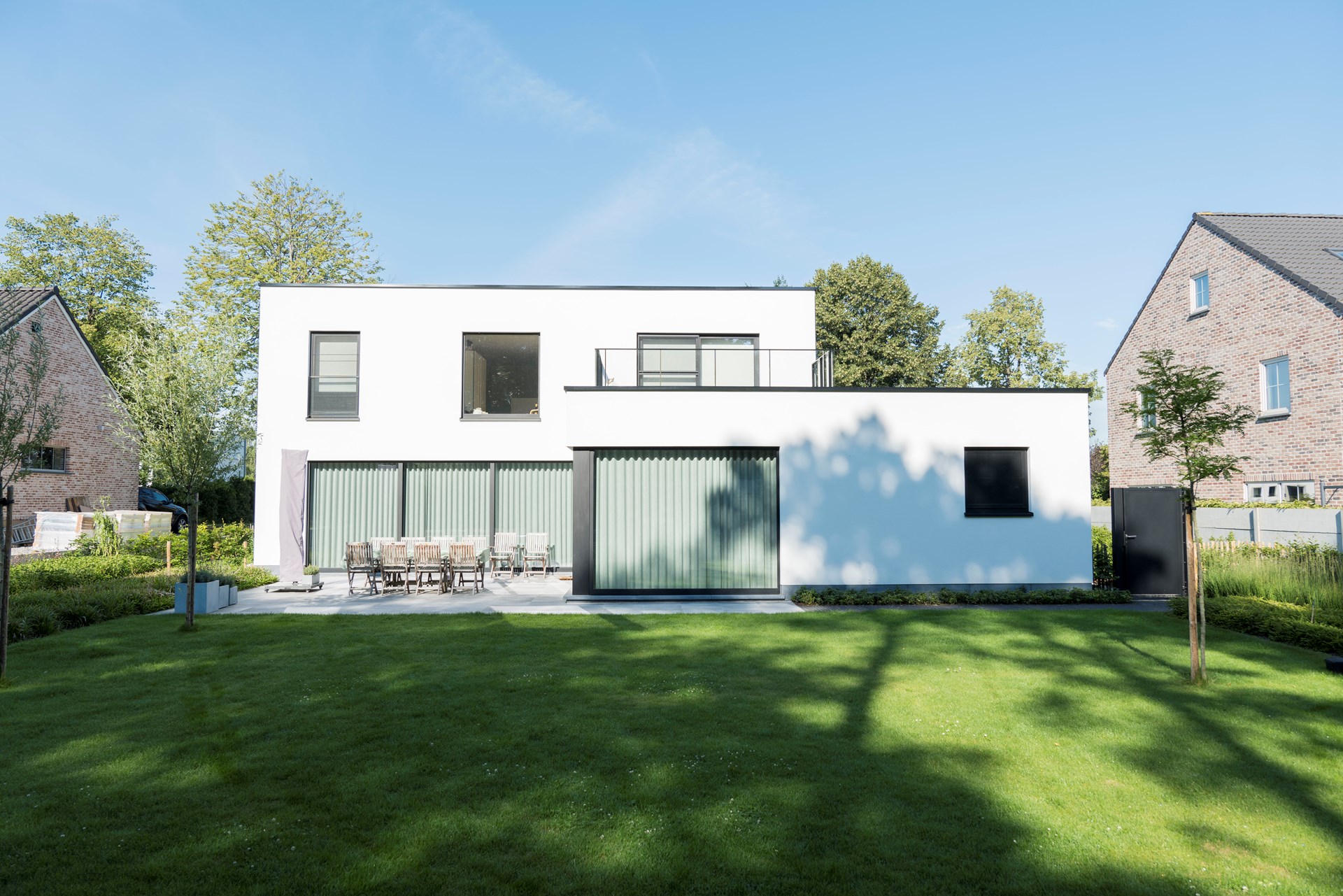
The houses are also always... the same. The variations in it are where the rectangle windows are and the length / width / height. But that is it.
I predict that in 20-30 years these houses will be seen as one of the ugly architectural trends of my time.
While houses that were built a century or even more ago (and that still stand) are lush with these ornaments and still retain a sort of beauty. [2]
I've lived in one of these type of houses and while they have some impracticalities because they have been built in a different century the outside stays a thing of beauty and you could guide people to your house purely because of how it looks.
Currently my wife and I are looking to build a new house and one of the requirements that we have for our architect is to build it with small details on the outside and a bit more classical than the current trend is.
[1] https://sibomat.be/media/f0xf52fy/moderne-bouwstijl-realisat...
[2] https://en.wikipedia.org/wiki/Oude_Markt#/media/File:Old_mar...

stdbrouw|2 years ago
[1] https://en.wikipedia.org/wiki/Georgian_architecture
yterdy|2 years ago
rsynnott|2 years ago
Examples: https://www.irishtimes.com/life-and-style/homes-and-property... - Fake Georgian townhouses. You're still left with a four storey house, which isn't super-practical, and they look ridiculous.
https://www.pjhegarty.ie/projects/esb-head-office/ - Replacing a distinctly un-Georgian Brutalist thing which itself replaced a row of Georgian houses back in the day. Again, looks silly, but if they'd played it completely straight they'd be left with a pretty impractical office building.
nemo44x|2 years ago
It’s why many homes today are built off existing models. But you see it in higher-end homes.
Now, of course the required parts could become mass produced if there were the demand. And I agree it’s a simpler and beautiful style. But you can’t put a flat roof on them.
Fluorescence|2 years ago
I find render is classic and beautiful but yes they are an ongoing maintenance issue to regularly repaint every decade or so and once the render has become damaged, rerendering the whole thing is eye-wateringly expensive. The main challenge is the right materials and expertise (lime render and porous mineral paint) which is expensive so people flipping a house will just bodge it with cement render and waterproof paints that will barely last a decade before it cracks, traps water, causes damp and starts coming way from the wall.
(Note that exposed stone also weathers and requires replacement which can make render/paint maintenance look very cheap).
A key part of the longevity of render is the design of other features e.g. you need correct channelling of water so it doesn't pour from roofs/windows down the render causing stains. This requires true skill and subtle architectural features like drip grooves carved under overhanging coping stones and subtle curves in the render itself (bell cast beading I think?). I am maddened by hokey designs that e.g. add a section of wooden facade above render which grossly stains the render below within months. It's just so careless and predictable. Any staining is a design fault that past experts knew how to avoid. There shouldn't be any "sources of colour" above render.
One of the joys of render is that you can personalise it with your own colours [2] which will stain less easily than white (grey is quite trendy) or even go for full graphic design [3] (I can't recall if those specific buildings were rendered - we have a tradition of drawing stone lines onto render so that it resembles limestone construction).
[1] https://images.mansionglobal.com/im-365825/social
[2] https://offloadmedia.feverup.com/secretbristol.com/wp-conten...
[3] https://www.bbc.co.uk/news/uk-england-bristol-57212364
paganel|2 years ago
stdbrouw|2 years ago
trgn|2 years ago
Kudos to Belgium to preserving its heritage so well, big thumbs down to being a black hole for architecture today.
xdennis|2 years ago
When you pay a fortune for the land and building materials you can't really build something nice.
When you have to comply with a million regulations, costs go even higher if you want an individualized house. If you keep it blocky and without decorations you can keep it affordable.
You would never get permission to build the Parthenon because it's simply not energy efficient.
Personally I think you should be able to build your own house without regulations, but not to sell it (i.e. you have to demolish it to sell the land). It's the perfect compromise between safety and freedom.
leoedin|2 years ago
The cost of complying with regulations when building a house isn't even particularly high. It's stuff like "use x thickness of insulation" and "design it with a protected fire escape route". It doesn't cost much at the design stage to take those into account. The dominating cost is materials and labour.
What regulations stop people putting ornamentation on their house?
randomdata|2 years ago
Isn't that always the case? I seem to recall that all architectural styles have been considered ugly 30-40 years after they were first in fashion. And then eventually they start to become appreciated.
modo_mario|2 years ago
quickthrower2|2 years ago
llamaimperative|2 years ago
Christopher Alexander's dissertation, "Notes on the Synthesis of Form" lays out a very compelling sociological explanation of how this happens.
TLDR: People initially create things (like houses) to solve local problems, usually their own problems, with the materials and methods they have locally available. As the craft develops, its practitioners start to compete directly with each other and the craft becomes "self-conscious." This competition finds increasingly esoteric "dimensions" to compete on, at the expense of solving the real-world problems the craft initially set out to solve. So consider e.g. early designers of chairs. They were looking for good places to sit that looked nice in their homes. Now, if you want acclaim as a chair designer, you have to design the most garish, over-the-top, wildly uncomfortable "chair" (sculpture) that you can.
FridgeSeal|2 years ago
Our residential house design is even worse, they’re uniformay the most bland, cookie-cutter-McMansion-trash that’s built in a way that’s almost actively hostile to its environmental conditions.
Gare|2 years ago
pmontra|2 years ago
somewhereoutth|2 years ago