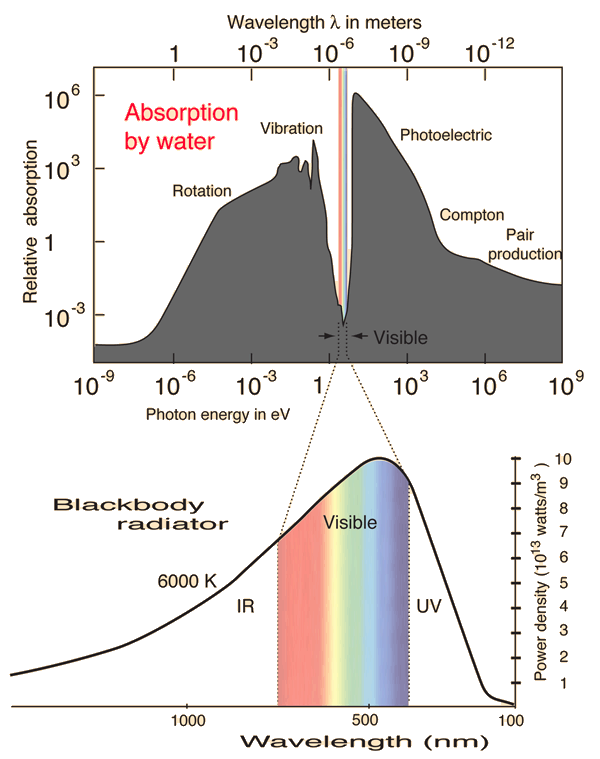
A bit unrelated but I found this interesting: water is transparent only within a very narrow band of the electromagnetic spectrum, so living organisms evolved sensitivity to that band, and that's what we now call "visible light".
I like to joke that while nitrogen gas is the most common thing around us, we are blind to it. Of course, that's a feature, since it allows us to perceive everything else further away, instead of stumbling through a perpetual fog.
This location-dependent tradeoff is something to think about when it comes to "false color" images in astronomy. If some aliens described Earth as "a boring uniform nitrogen-colored ball", we'd probably be a little offended at their ophthalmo-centrism, and tell them that the fault lies in their eyes, not in our planet.
visible light is also the last octave before you hit ionizing radiation. it’s very energetic. good for harnessing in chemical processes. not so energetic that the electrons leave the party.
At least he gave credit to HN, so the diaspora could find the source. The article is interesting. I think more needs to be said about how our eyes perceive color w.r.t. led lighting.
The sun is very close to a black body radiator, so all wavelength. The atmosphere and water filters a lot.
It is actually quite strange that plants are green -- that's the wavelength the atmosphere lets through particularly well, so would be particular good to be absorbed instead of reflected, for energy production. It seems nature hasn't come up with a good, cheap way to move the absorption into that wavelength.

Terr_|7 months ago
This location-dependent tradeoff is something to think about when it comes to "false color" images in astronomy. If some aliens described Earth as "a boring uniform nitrogen-colored ball", we'd probably be a little offended at their ophthalmo-centrism, and tell them that the fault lies in their eyes, not in our planet.
the21st|7 months ago
andyferris|7 months ago
It’s interesting (kinda optimal) that different cones explore near both edges.
cmrx64|7 months ago
dennis_jeeves2|7 months ago
peterisza|7 months ago
teslabox|7 months ago
doubleunplussed|7 months ago
But I guess it could be both.
davrosthedalek|7 months ago
It is actually quite strange that plants are green -- that's the wavelength the atmosphere lets through particularly well, so would be particular good to be absorbed instead of reflected, for energy production. It seems nature hasn't come up with a good, cheap way to move the absorption into that wavelength.