
(no title)
dmfdmf | 7 days ago
Off to a bad start. Aristotle was not making a mathematical point but a metaphysical one. Infinities do not exist and is not a number. For example, Pi is not a number but a symbol that stands for an open-ended (infinite) process to calculate a rational number and is a perfectly valid mathematical concept that, I am sure, Aristotle would agree. On any computer, despite protestations by the mathematical platonists, Pi is ultimately a rational number in all use cases involving actual measurement or calculations.
The error is illustrated in the first image in the article.
https://www.quantamagazine.org/wp-content/themes/quanta2024/...
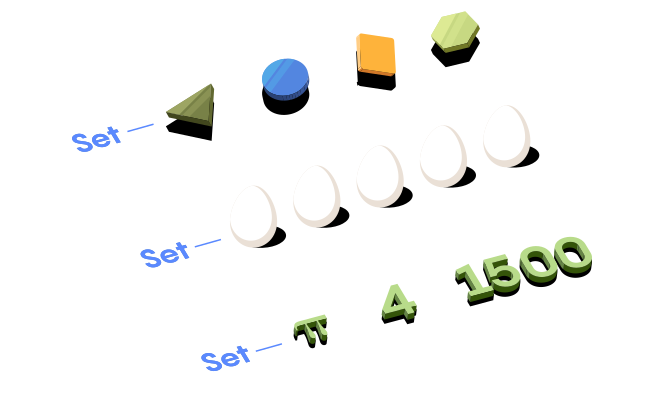
The third set in this example is an invalid and undefined set by including Pi since Pi is indeterminent and thus cannot be an object to be counted. All of Cantor's nonsense rests on this type of error, i.e. treating a mathematical process as a number. All of these errors are implicit in Newton's calculus and Berkeley's Ghost of Departed Quantities critique still needs to be answered. Hint; there is no such thing as infinite precision and epsilon/delta needs to be defined in a consistent way, not arbitrarily as it is now.
sixeyes|7 days ago
this seems weird to me. doesn't pi (the symbol) point to one specific concept, whether or not we can determine its exact shape?
dmfdmf|7 days ago
It is a subtle distinction but important. We define the exact value based on the context. If I am tiling my circular patio then 3.14 is fine to calculate how many tiles I need. If I going to the moon or mars then I need more decimals or I will miss the target.
kccqzy|7 days ago
dmfdmf|7 days ago
Not "most" but all real numbers are similar to Pi, i.e. they are symbols that stand for an infinite process to calculate a rational number. Both irrational numbers like Pi, e, etc. and reals exists and are legit and useful math concepts but infinite precision does not exist "in the wild" only in your mind as an abstraction. In any actual calculation or measurement your infinite series must stop and the dedekind cut must be made.
The ghost of departed quantities still haunts math. Is Pi 3.14 or 3.1416? Mathematically, it is neither and both because math intentionally abstracts from the precision of the ratio of the circumference to the diameter of a circle. These open-ended (infinite) processes are ultimately used to define a rational number, a ratio of integers.The finitist -vs- infinitist is a false binary which ignore that actual measurement must use rational numbers.
112233|6 days ago
When you prove, say, by induction, that p(n) holds for any natural number n, and hear you teacher say that p(n) holds for all natural numbers, you start forming the idea that "all natural numbers" is a thing that exists. The set N, you think, surely by writing it, all natural numbers are called into existance.
And then, much later, you come upon problem, where actual existence of the number becomes better defined. Say, like finding a large prime. And suddenly "all numbers" becomes a confusing mental burden.