
Karnickel | 8 years ago | on: Modern human brain organization emerged only recently
Karnickel's comments
Karnickel | 8 years ago | on: A conversation about how public transport really works
> The "America is too spread out" argument is total bullshit.
In support of this statement, here is a map of "mega regions": http://www.america2050.org/sync/elements/america2050map.png

Source: http://www.america2050.org/maps/
Alternative: "The Mega-Regions of North America" http://martinprosperity.org/content/the-mega-regions-of-nort...
> All told, these dozen mega-regions span 243 metropolitan areas in the U.S. and Canada, more than six in ten of all U.S. metros. They have a combined population of more than 230 million people, including 215 million from the United States or 70 percent of the U.S. population. Together, they produce more than $13 trillion dollars in economic output, equivalent to three-quarters of America’s total GDP.
Vast regions of the US don't even matter for the purpose of this discussion. When you only look at those regions the problem is no different than in a lot of other countries. That is also the geographical level where public transport makes sense, it's per-region (and different regions may want to/have to solve it in very different ways since their respective situations are different), not one solution for the whole country.
Karnickel | 8 years ago | on: Modern human brain organization emerged only recently
> the bold statements about no difference between men and women brains, everything is nurture/nothing nature, etc.
You are attacking a position that is not the common scientist position at all. Your whole comment is a bit surprising given the context. You went out of your way to invent a reason to vent.
"Study finds some significant differences in brains of men and women": http://www.sciencemag.org/news/2017/04/study-finds-some-sign...
https://stanmed.stanford.edu/2017spring/how-mens-and-womens-...
https://www.psychologytoday.com/blog/hope-relationships/2014...
It does not even matter how accurate any of those articles are, this just serves to show that the claim made by OP is wrong. There are plenty of science articles about differences.
So what exactly is the basis for your claim again? Did you do any research of your position at all (and just googling quickly before posting already counts)? It seems to be entirely made up.
> made up opinion
Such as yours? :-)
Karnickel | 8 years ago | on: After Surgery in Germany, I Wanted Vicodin, Not Herbal Tea
It's not paid by taxes but by health insurance. We have both a private and a semi-public system (managed by "Krankenkassen", independent insurance entities, that compete for members; it's... complicated, but less so than in the US, and it does not depend on the employer).
Some might say it's like a tax, it gets deducted from your paycheck, but then that's the same everywhere, including the US. Difference is that it's managed by independent entities and not the government, and they even compete. The private insurances are quite significant in Germany too. You are allowed to leave the government-mandated "Krankenkassen" if you earn over a certain amount of money per year, then you have to get private insurance - which is less expensive if you are young, but unlike the Krankenkasse family members (e.g. non.working spouse, children) are not included and it may become much more expensive when you get older, it's hard to predict because it depends on many factors including if you picked the right insurance company (that didn't lose as much money and now has to raise prices).
Karnickel | 8 years ago | on: After Surgery in Germany, I Wanted Vicodin, Not Herbal Tea
On the other hand, at least in the cities there is a ton of pharmacies - sometimes even across the street form one another, and easily every few hundred meters along major routes. There are way too many. When I walk through downtown Nuremberg I walk past several of them, right on the main pedestrian-only street of the city. And they are all allowed to advertise in their shop windows. So that's some prime advertising space, right in the hard of the city. On my way to downtown, a twelve minute walk, I walk past four pharmacies if I take the route along the street (vs. the lake route, which is a park).
Also, they are allowed to advertise for things like cold medicine, when I still had a TV (log time ago, admittedly) I remember seeing lots and lots of such ads: "WICK MediNait cold medicinefor the night", list of ingredients: https://www.aponet.de/wissen/arzneimitteldatenbank/suchergeb... (active ingredients Paracetamol, doxylamine hydrogen succinate, ephedrine hemisulfate, Dextromethorphan hydrobromide-1-water)
Karnickel | 8 years ago | on: After Surgery in Germany, I Wanted Vicodin, Not Herbal Tea
> it should be up to me if the pain is server enough to warrant opioids
It is!
You do get the drugs you need. If you actually ARE in pain. But this woman, as predicted by her doctor, was not. If you read the article, she did not have the pain, it was only fear of it.
Society does have to pay the price in the end if people are given what they want. See the problem of over-subscription of anything from pain killers (in the US) to antibiotics.
Not least, those drugs show up in ground water and in drinking water supplies, and water companies can't really filter that stuff out.
https://www.scientificamerican.com/article/pharmaceuticals-i...
https://www.webmd.com/a-to-z-guides/features/drugs-in-our-dr...
If you think "the levels are low - that is save", there is no scientific basis for such a statement. We have no clue what low-level exposure to drug cocktails does.
Karnickel | 8 years ago | on: After Surgery in Germany, I Wanted Vicodin, Not Herbal Tea
Not sure how you manage to come up with such a comment after reading this particular article. Clearly she did not have the pain she feared she would have. She said she took two Ibuprofen - that she did not need!
So why would you think she would have been better off taking drugs against pain that she didn't have?
Real pain is treated here in Germany - of course!
But taking pills for mere fear of pain that isn't even there?
I had had four wisdom teeth removed all at once, that's when I got and took a few (a few!) Ibuprofen during the following week. Only because I actually lived and worked in the US at the time (but had the surgery done during a vacation in Germany), and had to go back to work, doing IT training for a few days. Otherwise I would have taken even less.
Later I had jaw surgery, lower jaw extension by 4 mm (no metal left inside me, by the way, it was a z-cut followed by the shift and half of a bone could reattach to the other half, just shifted lengthwise a bit), so a complete cut through the lower jaw. I did not need a single pain pill.
Karnickel | 8 years ago | on: Deep-copying in JavaScript
In most common cases, like shallow clones and cloning simple objects, are already well-covered and solved, often with very few lines of code or even just a single command (`Object.assign()`). Stage 4 draft (i.e. it will be in the next version): `{ ...obj }` to clone an object [0].
Cloning Arrays, Maps, Sets is easy using their default constructors in a single line, such as `new Map(originalMap)` or `new Set(originalSet)` [1]. You can clone an array using spread syntax or `Array.from` [2].
Another issue is that there are many variants of "deep cloning". Some people only need actual "regular" object properties cloned - copying objects without any of the features you get through `Object.defineProperty()`, like object literals.
Some people want symbols cloned, others don't.
Some people don't care about functions. Some people want some things, like functions, not cloned but referenced to avoid duplication.
Some people want all the options copied that you get from `Object.defineProperty()`.
Some people care about the prototype chain, others don't (if you only clone regular objects, e.g. from object literal object creation and similar ones).
So there is huge variety about what people need when they talk about "deep-copying" in Javascript, because objects have so many optional features, but most of the time they are not needed or not relevant to the copying.
As others have said, it also is not actually all that essential. I use a functional style without OOP (this, bind, class (ES6 or ES5 "pseudo-class" construction), try not to mutate, and I rarely need deep-cloning, if at all. I think right now I only use my carefully crafted and speed-tested deep-clone module in tests. Each time I started using it in my code I eventually came up with a much better solution that didn't need it. Note that I did not actively try to avoid it, it just happened - the use case went away by itself each time I came up with an improved version of the code.
[0] https://developer.mozilla.org/en-US/docs/Web/JavaScript/Refe...
[1] https://stackoverflow.com/a/30626071/544779
[2] https://www.briangonzalez.org/post/copying-array-javascript
Karnickel | 8 years ago | on: Why Is Bitcoin Valuable?
> You haven't provided any argument in how they are different
You are quite the joker. Or maybe you have some real problems reading English?
Try again: https://news.ycombinator.com/item?id=16197689
Of course, it's been quite obvious for a while that you are just trolling.
Karnickel | 8 years ago | on: Why Is Bitcoin Valuable?
> that your claim that there isnt at all is wrong.
Well, it isn't, as I already pointed out. Is the main strength of your argument how often you repeat it?
> So your claim is simply wrong.
Ah, yes, as I suspected. A strong conviction in place of arguments, reasoning and considering other people's arguments.
Karnickel | 8 years ago | on: Why Is Bitcoin Valuable?
Do you seriously compare the total amounts of something HUGE and something tiny? The size of the cash universe still is orders of magnitude larger than Silkroad ever was - and you compare the totals? Seriously?
Karnickel | 8 years ago | on: Why Is Bitcoin Valuable?
I don't understand what your question has to do with anything I wrote. Unless your intention is not an actual honest discussion, but to mislead - but surely that cannot be true.
Karnickel | 8 years ago | on: Why Is Bitcoin Valuable?
Not like cash at all. You can't pay with cash unless you are right there. Also, paying with large amounts of cash is hard or suspicious or even impossible.
Karnickel | 8 years ago | on: Why Is Bitcoin Valuable?
I think your comment raises some very interesting points, but that you go too far.
There are costs (in the wider not just monetary sense) and benefits to various approaches. The reason you had to resort to crypto-currency first of all seems to me to be the problems in the countries you lived in. If they had working institutions, if you had lived in a Western country and had had access to the banking there, would you have come to the same conclusions?
Also, there is a reason why Western banks and Asian ones too, it seems, prefer losing business over dealing with customers from some countries, and I doubt the reason is spite.
Having completely anonymous money sure benefits some small businesses (mostly those living in places with bad institutions), but it also enables a lot of very questionable businesses and people. I would suspect that as far as volume goes the latter might actually be far bigger than the former. As always those who have most to gain are those who have a lot of money to move (same with the question about who benefits from government more - the rich or the poor? The rich! Any "redistribution" is dwarfed by the amounts of money people get to make and to keep under the protections of strong government institutions). Anonymity, not just for money, always works for those who have their eyes closed to all the horrible things humans do when nobody is looking - and that is not a negligibly small amount. Of course, the extremely wealthy already have "anonymous money", tracing who owns what is very hard even for the government, but I doubt giving everybody access to anonymity would be a net positive.
Karnickel | 8 years ago | on: Microsoft MakeCode
As a software architect (current title, but I had a technical education, "electrical/mechanical", incl. technical drawing, lab work, metal work, decades ago, before studying CS), who prefers text most of the time I still can see the appeal of something like this (All links lead to pictures):
- http://forums.ni.com/legacyfs/online/202594_Hololens_LabVIEW...
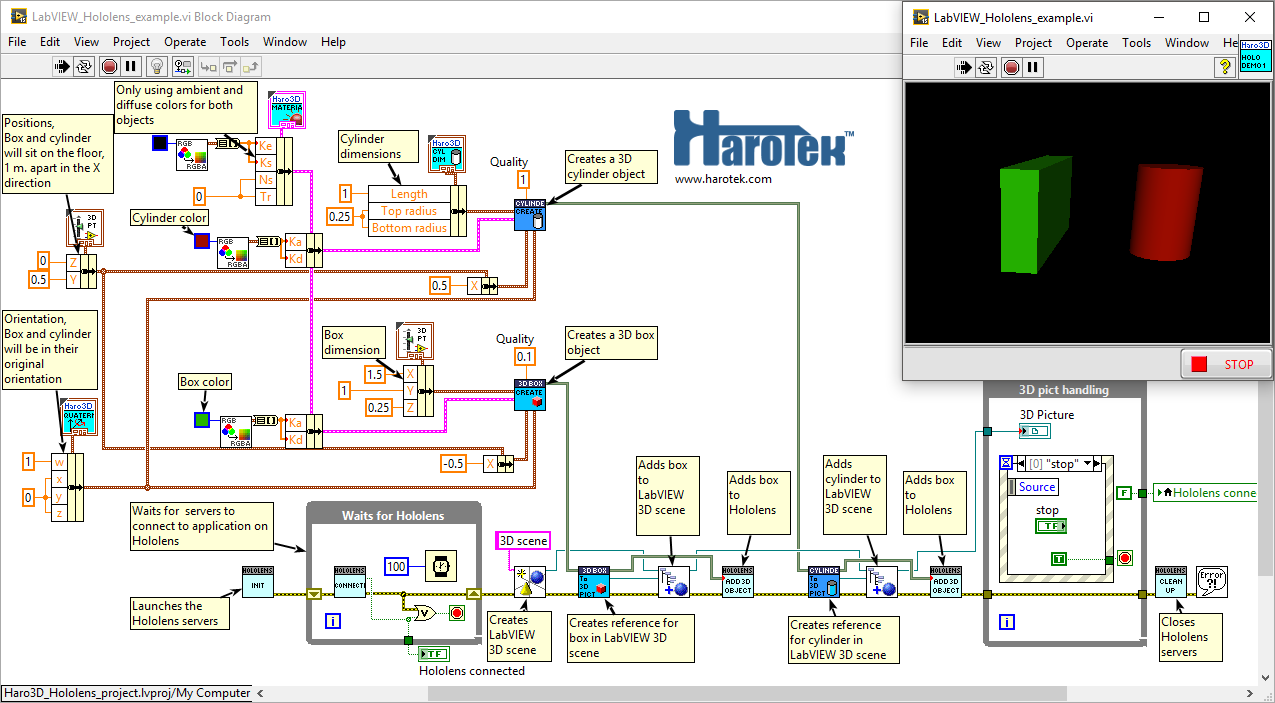
- http://sine.ni.com/cms/images/casestudies/a14_02.jpg?size

- https://m.eet.com/content/images/edn/LabVIEW-NXG_editor_1920...

Even this is not any worse than a complex text-based software project, you can zoom to the part that you want to look at in detail, just like you navigate between modules/classes/code files:
- http://www.ni.com/cms/images/devzone/pub/nrjsxmfm91216399872...
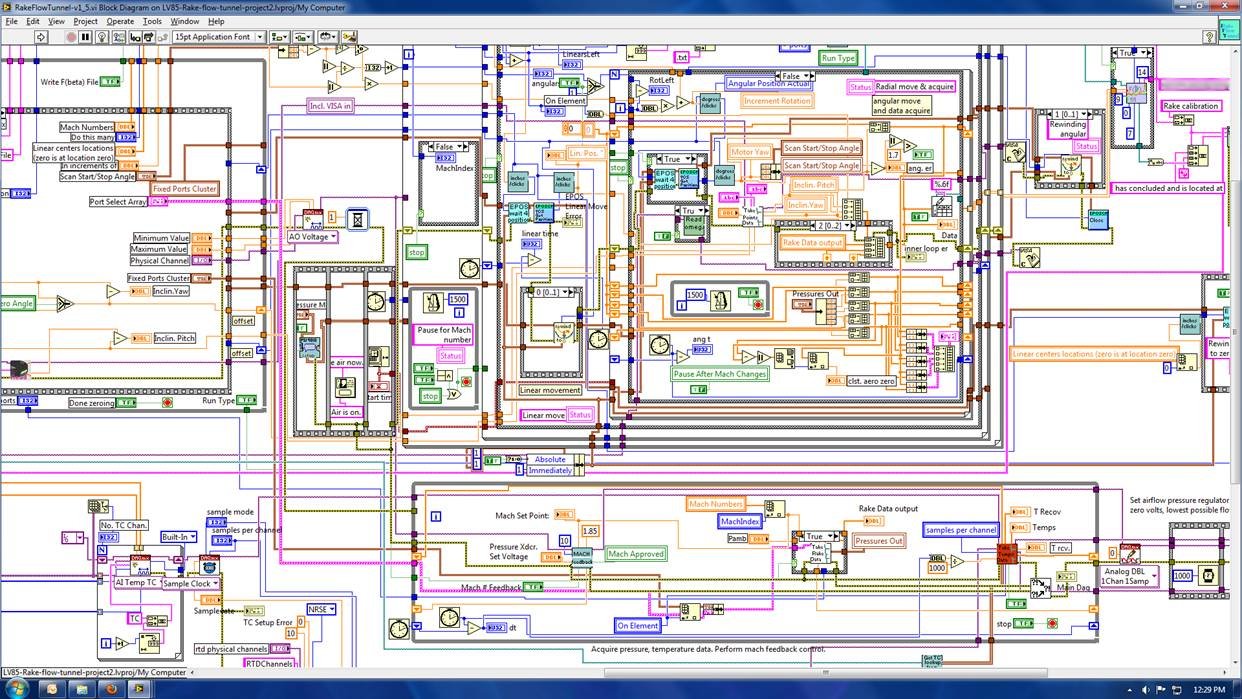
Also beneficial for a visual approach is that that is how electrical circuits are visualized. It's been a long time, maybe they describe more electrical circuits in text (I know VHDL but that is not for all kinds of circuits, nor does it concentrate on the electrical aspects), AFAIK it's still mostly diagrams.
Another point is that unlike software, where you deal with abstract things in any case (even registers, if you program in assembler, are pretty abstract). What you design in LabView is made of actual physical components, and you really physically run wires from one to the next.
What is shown as an enclosing box with "gates" between inside and outside as in this diagram really looks like this, LabView is a simulation of a physical system:
- http://www.egr.msu.edu/classes/me451/me451_labs/robot/LabVIE...

I have done quite a few courses (edX, Coursera) over the last few years, and when there were LabView portions I had no difficulty and actually found it quite appealing. I would not say the same for software, where I still prefer text.
Karnickel | 8 years ago | on: No, machines can’t read better than humans
if bots can produce 'worthy set of opinions' we would be totally useless
Apart from quality and relevance considerations I'm reminded of the situation where people open businesses that already exist, or people try to get jobs despite other people existing that are actually better. For example, why doesn't BMW stop producing cars, after all, there's Mercedes-Benz (and very close too), or vice versa. Or why is there yet another bakery. Or why do I try to get that programming job and don't even mind to admit that I'm probably not even among the best 1% of people for that particular job. Because none of that matters. My advantage in the last case is I'm here (interviewing) while those other people are not. Same with the bakery and the car makers. The existence of something else isn't a reason unless there is a direct impact.
Even if we ever make something that is far more intelligent than us. Still no reason to expect that that new thing is going to murder each and everyone. We don't murder each and every creature that is orders of magnitude less intelligent than us (the extinction event that we started notwithstanding, that's a side effect because of limited space on the planet). We don't murder our own less intelligent members of society either.
To extend on the last point, the real human intelligence is not as much in the individual members of this society - but in the network that we present. Place any human being alone in a remote region and see what they accomplish. They will actually die, most likely. The power of humanity is not the individuals, it's a huge invisible "cloud" of stuff: The knowledge, the "magic items" that were created by this "human cloud" over time (like a computer, or just a can of Coke [1]).
Even if we created something that is an order of magnitude more intelligent than any human being, or even two - it's power (and intelligence!) pales compared to the combined network power of humanity.
Don't look at "humanity" as a bunch of individual hairless mutated apes (i.e. the physical, biological beings), "humanity" is much, MUCH more, most of it invisible to the eye. Knowledge/culture, the way we interact in a gigantic network (like a brain - think of humans as neurons!), the tools and items we have.
In this network there is plenty of room for new "nodes", and if they are truly intelligent they will value the network and - unlike most humans - recognize that their own individual abilities are tiny compared to being part of the whole thing.
Another things is, when/if we can create things that are "better" than us we can also change ourselves. We can improve our bodies, our brains. We will integrate computers and brains, not have them (only) externally. So the humans that "compete" with some super-intelligent AI won't be the humans of today either.
Also check out:
[0] "Joseph Henrich: "The Secret of Our Success" | Talks at Google" https://youtu.be/jaoQh6BoH3c
> Humans are a puzzling species. What has enabled us to dominate the globe, more than any other species, while remaining virtually helpless as lone individuals? Joseph Henrich's shows that the secret of our success lies not in our innate intelligence, but in our collective brains—on the ability of human groups to socially interconnect and learn from one another over generations.
[1] "What Coke contains" https://medium.com/@kevin_ashton/what-coke-contains-221d4499... (it is not actually about Coke)
> The number of individuals who know how to make a can of Coke is zero. The number of individual nations that could produce a can of Coke is zero... Invention and creation is something we are all in together. Modern tool chains are so long and complex that they bind us into one people and one planet. They are not only chains of tools, they are also chains of minds: local and foreign, ancient and modern, living and dead — the result of disparate invention and intelligence distributed over time and space. ...every can of Coke contains humanity’s choir.
Karnickel | 8 years ago | on: No, machines can’t read better than humans
> I'm pretty sure no one is seriously remotely claiming that machines understand text better than humans.
Just some of the headlines:
- http://money.cnn.com/2018/01/15/technology/reading-robot-ali...
"Computers are getting better than humans at reading"
- http://fortune.com/2018/01/15/artificial-intelligence-ai-chi...
"Computer AI Can Now Read Better Than You Do"
- https://gizmodo.com/ai-used-to-sell-you-more-stuff-can-now-r...
"The AI Used to Sell You More Stuff Can Now Read Better Than a Human"
Karnickel | 8 years ago | on: Convert React JavaScript Code to TypeScript with Proper Typing
I've been a heavy user of Flow for - two years now? I also occasionally use TypeScript. I don't contribute to the code (in the Flow case, I don't speak OCaml, I contributed a bit to the type library and the online docs; in the case of TS, I don't use it enough), but I write a bug report each time I find an issue.
I've been looking at the issues list very often, mostly out of curiosity to see what the problems are that people have (both Flow and TS) and to see which project is better at solving problems.
TypeScript seems to win hands down. Their ratio of closed tickets to open tickets is far better than that of Flow:
- TypeScript: 2,515 open, 12,716 closed -- https://github.com/Microsoft/TypeScript/issues
- Flow: 1,830 open, 2,467 closed -- https://github.com/facebook/flow/issues
I have to assume they mostly close issues after solving them - it is not unheard of that issues are closed merely because they've been lying around for a few months without any updates (definitely happens for Flow).
I prefer the approach of Flow, but I think the actual developers are not present at all on Github, most answers come from other users. There are very few actual solutions to issues that are raised. The list of issues grows ever larger. Flow does make progress, and it's not even bad. Every 10-15 days we get a new release and I'd say the progress is quite okay. What went really well the last 12 months was IDE integration for Flow in the case of Jetbrains Webstorm (for TS the situation always looked good), as of now, latest Webstorm version, it's actually usable. I still get too many Flow server crashes though, which may be due to my platform (Windows 10), not sure. However, it's now automatically restarted most of the time.
A TypeScript anecdote: I filed an issue that a "Member" closed as "works as intended" after a few comments back and forth (but it was clear right away that this would be the end). I filed it again - this time Anders Hejlsberg himself responded and acknowledged the issue (it was kind of fundamental and not just something unimportant), and it got fixed. So here too you need a bit of luck to get through to someone who actually understands the subject well enough (including knowing when they don't understand it, if that first guy had just stopped handling my issue it would have been fine). But that's the price of using a popular large project, so this is not a complaint - just an anecdote, okay?
What I do get for myself after following the two type systems for well over two years is that there are LOTS of restrictions. Just read some of the issues in both Github repos, it's really interesting.
I find the whole situation very unsatisfying. It is clear - when you actually use it heavily for a big project for a longer period - that a type system on top of Javascript is very difficult to maintain. LOTS of unsolved cases and issues. You definitely have to adapt and use only the subset of Javascript and the type system that works. I validate an object manually and I still have to do an "any" cast in Flow because Flow does not recognize that my `if` statement secures the type. Or I have to insert such `if` statements even though from the context it is perfectly clear what I get there. For example, any inner functions, e.g. when using map, filter, reduce, loses the type if you use a variable from the outer scope. Or you have to use a lot of additional `const` for object properties even though you don't change the object - but the type checker is not intelligent enough to recognize that. You definitely write different code - and while that may seem okay there are plenty of cases where it really is objectively unnecessary, but you have to do it to satisfy the type system.
On the bright side, once you get your code all "type system ready" you really do find bugs - even if it's just a few. Also good is that I now get much better autocompletion suggestions in the IDE. There's a reason why I (as project head) still insist on us using Flow even though I say "WTF?" often enough. It does cost a significant amount of time though - a very significant amount. I've been willing to do it because of the kind of project, which is going to be a very low-level building block for later larger projects, so it is worth spending a lot more resources on getting it right compared to a project that's on a top layer, on which nothing else depends.
Still, overall I have very mixed feelings and I see the type checkers (both TS or Flow, or any other that could be written) on top of a language that doesn't have types as a kludge that does not look like a long-term solution. There is too much friction between the language and the type system.
Karnickel | 8 years ago | on: A Type of Road Junction that Kills Cyclists
I won't dispute it because of the general "If you've never seen a black swan, is that proof that none exists? (No)" fallacy, but speaking as a German, I cannot remember having seen one in Germany, ever. So even if one exists it's an exceedingly rare thing.
When I lived in the US I always found it unnecessary that everybody has to stop. In Germany we always have a "main" road and a "secondary" road, and those on the main road don't have to stop. That priority pattern is kept from major roads to tiny roads. Then there's the "right before left" rule when the roads are equal - creating a priority without signs and without "everybody has to stop" rule.
Karnickel | 8 years ago | on: Microsoft disables Windows Update when Meltdown/Spectre registry key isn't set
I know I won't get any updates for the system for my 2012 Dell XPS 8500 (256 GB SSD, 16 GB RAM, i7 CPU - I don't see a need for an upgrade, it's all there).
Does that mean I'll just be left out cold? That's how I understand it.
When I run the Microsoft Powershell plugin that they made available to check the protection status (`Get-SpeculationControlSettings`) I get a "True" for 3 of 8 items (only showing those 3):
  Windows OS support for branch target injection mitigation is present: True
  Windows OS support for kernel VA shadow is present: True
  Windows OS support for kernel VA shadow is enabled: True
page 1
What is the purpose of finding someone, anyone, who holds some fringe opinion to attack it as if its common? You can find any opinion about anything out there after all.
> Quoting some articles arguing that there are differences doesn't prove anything.
It proves that the opinion you attack does not seem to be the opinion of the scientific community. Unfortunately you did not include a single link to show whom or what exactly your comment is about.
I hope you don't consider it rude or an "attack" that I point out that you did not point to anyone/anywhere specifically? Because you really did not. I think your argument would benefit greatly from being more specific.
I have Facebook friends (who I keep because they are ex colleagues and mostly harmless otherwise) whose whole life (judging by their news feed) seems to be centered around finding the most stupid comments on the entire Internet and then posting them to show how stupid they are. Your comment strongly reminds me of that phenomenon. Personally, I consider it not only highly illogical but also a huge waste of time, not to mention what it probably does for your outlook on life to concentrate on the most absurd and ridiculous fringe opinions that you can find.
Also, counter to your latest claim, you make no such distinction at all. You attack the position as if it's common. The Facebook friends I mention at least include specific links that they attack. Not that that would make much sense given that we are here discussing a specific article.