
exue | 12 years ago | on: Why 'gallons per mile' is better than 'miles per gallon'
exue's comments
exue | 12 years ago | on: My 7-Year Old Daughter’s First Programming Experience
Agreed - you can't really do much without variables/primitives first. Which are might be conceptually harder to grasp
exue | 12 years ago | on: My 7-Year Old Daughter’s First Programming Experience
With web programming, a lot of the initial hassle and set up is gone, and visual learning/iteration by hitting refresh is very easy. So I would say, almost as young as they can play around with a web browser, and type on a computer. You can immediately start seeing results by typing in the Chrome inspector console. I think even a 4-year-old would be able to understand an if/else, but I'm not behavioral psychologist.
exue | 12 years ago | on: Why 'gallons per mile' is better than 'miles per gallon'
Got it - I think you're asking why the peak is still so low at 40mph, and why we haven't shifted it toward 55, or 65. The reason there is a peak at all and we aren't most efficient at 5mph is due to (1) for gasoline cars, low efficiency at low loads - a motor may have a maximum of 200hp but only asking 10hp to power you means you'll pay a lot of frictional/throttling losses (at 10hp you'll be in the far bottom left in diagram [4]) (2) "fixed costs" per unit time - power steering, power brakes, alternator for electronics. Those two factors push us out to the right, whereas wind and rolling resistance push us to the left.
I'm not an automotive engineer so I don't understand the overall system equations, but I suspect for a given vehicle weight of ~3000lb, drag coefficient ~0.30, and 4-cylinder gasoline motor characteristic that provided sufficient passing acceleration, the "solved equation" for economy cars happens to end up in in the 35-45 optimal range. Gearing can't move the peak so much as make the decline less severe. (In my experience 4 speed autos generally had similar top gear ratios to 5 speed manuals of the time, but had other losses/at in-between speeds)
If you wanted to just shift the peak to the right, you could (1) equip an engine that is very large/extremely inefficient at low power outputs, and had higher parasitic losses and (2) reduce drag. Thus, it would make sense to drive faster, to move your motor out of the extreme bottom right in [4], and "spread out" those parasitic losses over a larger distance.
Adding more gears makes the slope go down less steeply after 40mph (but it's always going down consistently - see the Motor Trend article). The reason I used a 90mph example is I believe most 6 speed transmissions today already have 6th gear optimized for ~70mph cruising due to their motivation in post-2006 EPA testing. By optimized, that doesn't mean the optimal MPG in that gear occurs at 70mph, just that we've eliminated the gearing mismatches/inefficiencies compared to a CVT, which always has "perfect gear ratio". You could still add a 7th and find improvements at 80/90 probably.
So if 5th gear (in a 6-speed) had optimized 40mph, and 40mph is inherently more efficient, we would be driving there instead for overall peak MPG. I was trying to say that with enough gears, you don't need to be in top gear for optimal MPG due to drag. Hope that makes sense
exue | 12 years ago | on: Why 'gallons per mile' is better than 'miles per gallon'
Good catch! Knew I was missing something when the other comment referenced a quadratic relationship. (Updated)
exue | 12 years ago | on: Why 'gallons per mile' is better than 'miles per gallon'
Longer gearing will improve the high-end efficiency where it wasn't yet optimal - to help 90MPH you could target that with your super 7th gear at "ideal" torque/RPM. However the overwhelming aerodynamic drag means the peak efficiency won't shift to the right much, and it'll probably stay around 40-45mph (the power required is proportional to the cube of speed and 11x stronger at 90MPH than 40MPH) [4]. In many cases that super 7th gear wouldn't help 40mph (peak) at all if 5th/6th had already optimized 40mph.
I think the 55-70 range is pretty optimized on production cars today, including those with 5 or 6 speed transmissions - but you may be able to make more gains with longer gears/a CVT at speeds above that. In an earlier age of 3-4 speed autos (and sometimes a national 55mph limit), manufacturers had fewer gears to work with so a super long gear for 80MPH efficiency would trade off midrange efficiency and acceleration, and the EPA didn't test that anyway until 2006 w/ higher highway speeds
[4] My reference on the ~40MPH ideal speed (which I'm now more convinced about is the ideal for cars today) is the Motor Trend [1] test (all economy sedans peaked 35-40ish), several Hypermiler/car specific forums [2] and some personal cruise control tests with some rental/Zipcars with a digital gauge. Other ways to test include Scangauge/the Torque Android app. (The reason the ~40mph peak isn't even lower, is due to gas engines especially larger ones, being less efficient if they produce too little power - there is a minimum RPM at idle and always friction). So my earlier statement of "optimal peak would have been 30-40" - it's already around 40, and it doesn't have to achieved in top gear.
I put "ideal" in quotes earlier since the torque peak is one of many factors for the engine - the ideal cruise RPM is almost always lower due to less engine friction and lower pumping losses when you aren't asking for full power. If you ask for more power, your optimal RPM goes up closer to the torque peak. A generic motor from a friend's auto engineering class [3] (If you say had a Honda S2000 with a torque peak at 7500rpm, cruising there would kill your mileage)
Yeah, though by 4-wheels-on-ground I was mostly referring to flying/maglev type vehicles, or perhaps a vastly different design that had very little aerodynamic drag
[1] http://image.motortrend.com/f/roadtests/sedans/1208_40_mpg_c... http://www.motortrend.com/roadtests/sedans/1208_40_mpg_compa...

[2] http://www.metrompg.com/posts/speed-vs-mpg.htm http://www.metrompg.com/posts/photos/florida-speed_vs_mileag... http://www.metrompg.com/posts/rpm-mpg.htm
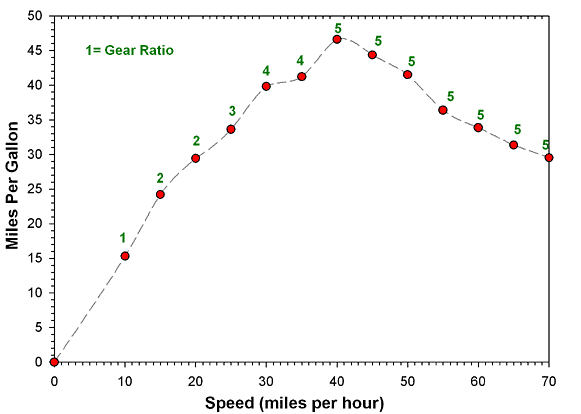
[3] http://i.imgur.com/5MEEDnx.jpg - the asterisk would be near the torque peak

exue | 12 years ago | on: Why 'gallons per mile' is better than 'miles per gallon'
The thing is we have a lot a lot of leverage on the technological side. Choosing a behavioral and societal change vs. technological is always a trade off - but for this case some things make improving the technology much easier. The median age of a car in the US is about 11 years vs. 36 years for homes. Cars are individually replaced whereas reconfiguring homes that are on fixed land is a much more difficult task. If you're asking about an individual level I agree it's a choice, and you've covered those pain points say within a metro area. However if your family is in many South/West cities - say the Houston metro area or Las Vegas, distances are going to be pretty far. Amazingly, Los Angeles actually has pretty low average miles per year - one of the lowest for metro areas.
While the technological advancement is pretty much a universal win, the behavioral change isn't, or is at least debatable/not everyone's cup of tea - a lot of Americans prefer to live in large houses with lower density neighborhoods (of course others prefer large dense cities). Many also live in rural or semi-rural areas, and the US has a lot of cheap land compared to say Western Europe. Zoning in a city is dictated by those residents. However with better technology and cheaper energy, the expense of this lifestyle will be lowered and allow more choices (similar to how remote work allows people to remove geographical limitations). If we think about developing countries, any efficiency gains will also reduce their energy impact as consumption increases
exue | 12 years ago | on: Why 'gallons per mile' is better than 'miles per gallon'
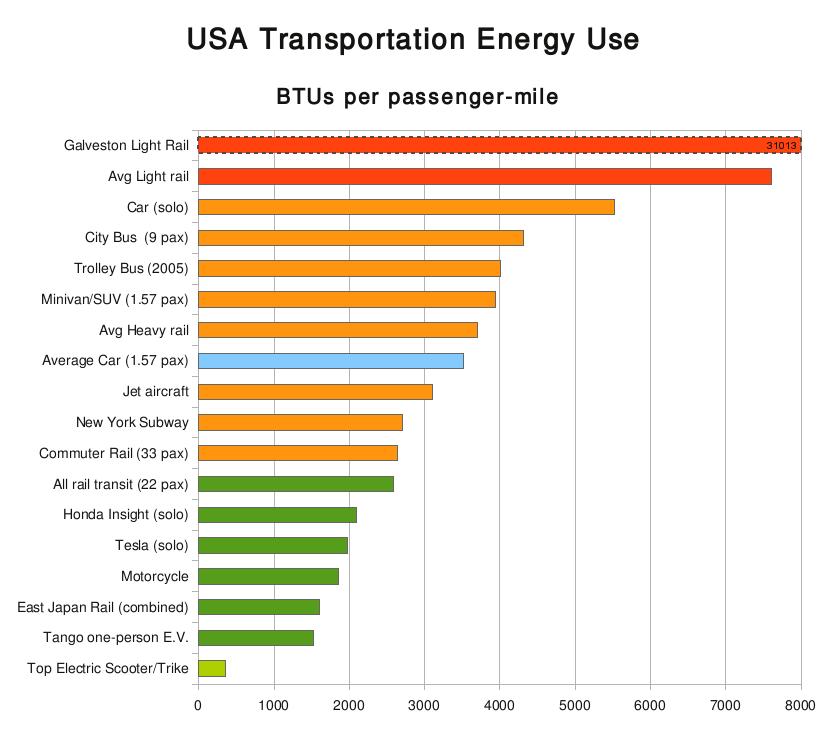
Right now local transit in the US is often less energy efficient per passenger-mile than a solo-driven Prius or Insight, or even the average-loaded (gasoline) passenger car. The numbers vary of course based on passenger load and route efficiency of course.
exue | 12 years ago | on: Why 'gallons per mile' is better than 'miles per gallon'
OK, now I understand where you're coming from. The physical limit is that at higher speed, we must expend more energy per unit of distance, to overcome drag (relatively little is lost in braking or rolling resistance of tires.) [1] So on any planet with an atmosphere you will have to contend with this.
The 'ideal' speed isn't really even 55MPH, but lower if you had all variables at play to get the maximum MPG at any speed (probably 30-40MPH), but manufacturers expect people to cruise on the highway faster so they adjust the gearing. If you're asking how to push out the curve so that going faster than 75MPH doesn't offer a huge loss of speed, lower drag coefficients are the trick. Or switching out of the 4-wheels-on-ground automobile.
[1] http://upload.wikimedia.org/wikipedia/commons/thumb/0/05/Ene...
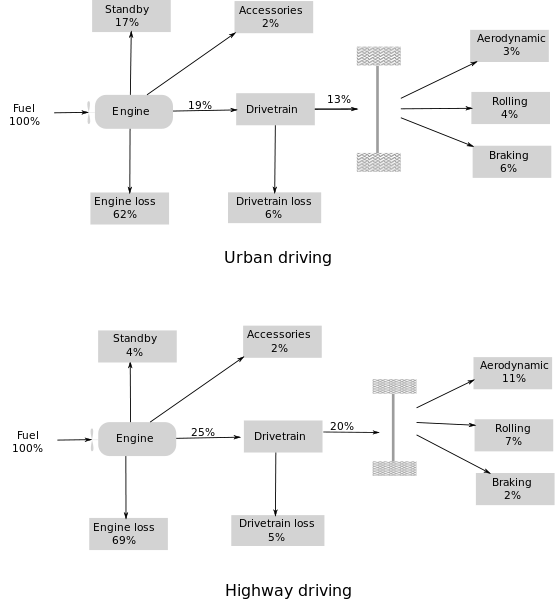
In this generic diagram, the ratio of drag (air)/rolling (ground) resistance is 11-to-7. As you get to higher speeds, the ratio tips even more in favor of drag.
Fun fact: The Bugatti Veyron gets 2.15MPG at its top speed of 250MPH.
exue | 12 years ago | on: Why 'gallons per mile' is better than 'miles per gallon'
It's not always the most efficient for every car, but there are lots of charts showing this tradeoff. Some cars are more efficient at 65 or 70 than 55 (97 Celica), but in modern gas cars, 40-50mph is where you hit a peak, and you start getting worse from there. 40mph on the highway is painfully slow though, so people generally pick an optimal point higher than that.
(One inconsistency I've found is how the Motor Trend test below sees a very high peak at about 40MPH and a decline after, while other sources show a flatter peak). And 55MPH seems more like a magic number the author picked, but not a bad one if we don't know the model.
Generally cars are geared so the engine begins entering its optimal / most efficient RPM range where it can produce more torque in top gear around 40-50mph, and rolling resistance and wind drag (which is a cube function of speed) contribute to make mileage worse after that. Usually the speed at which you first shift into top gear and cruise comfortably is close to optimal. Efficiency doesn't start dropping for a while because of the cubic nature of drag, and the engine sometimes is more efficient at higher RPMs for a bit (see nols' post on manufacturer optimization).
Fun fact: At top speed (254mph), a Bugatti Veyron will use its 26 gallon tank in 12 minutes.
An older chart:
http://upload.wikimedia.org/wikipedia/commons/a/a9/Fuel_econ...
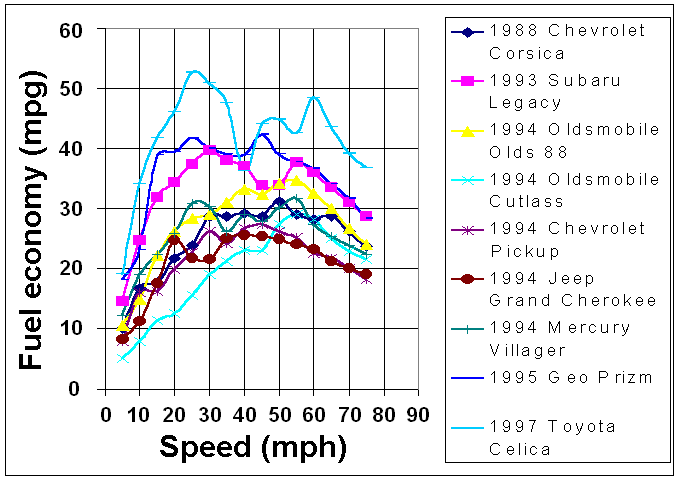
A newer chart: http://blog.automatic.com/wp-content/uploads/2013/12/mpg-vs-...

Motor Trend chart: http://image.motortrend.com/f/roadtests/sedans/1208_40_mpg_c...

http://www.motortrend.com/roadtests/sedans/1208_40_mpg_compa...
(One thing that bothered me is how the Civics in the last two charts were so different)
exue | 12 years ago | on: This girl in SF stole my MacBook Air
In a way, it also helps turnover of tables - it's a soft way of ensuring new customers can get seats and the people who got there first don't stay all day (short of an explicit X hour limit)
exue | 12 years ago | on: Show HN: InstaMotor – Taking the pain out of selling your car
Great points, especially on the loans. I'd like to add that you don't need REG 262 except in special circumstances, such as if the seller doesn't have the current title, or with loans (maybe that was part of the context though) [1]. But avoiding that trip to the DMV is a great blessing
When I sold my vehicle in CA, both the buyer and I filled out the transfer of liability online [2] - no appointments needed. The title ("pink slip") contains the bill of sale with the odometer reading that you would otherwise put on REG 262. The buyer and seller both sign the title which also has the paper version of the transfer of liability should you be inclined to mail it. The buyer generally will have to go to the DMV to pay use tax and turn in the old title.
[1] https://www.dmv.ca.gov/pubs/reg_hdbk/ch5/ch5_5.htm [2] http://www.dmv.ca.gov/online/nrl/welcome.htm
exue | 12 years ago | on: Show HN: InstaMotor – Taking the pain out of selling your car
Great, this adds a lot of trust for me!
last thing I thought of - how is the communication facilitated? ex: asking questions about the vehicle's history
exue | 12 years ago | on: Show HN: InstaMotor – Taking the pain out of selling your car
In California it's even easier than getting a notary - you just need signatures on the title ("pink slip"), and then both parties can fill an online form for transfer or liability. The buyer then goes and hands over the title to the DMV at some point in the next (10) days, getting a new title in the mail.
For as well me I've had a decent experience on Craigslist - just some due diligence and research on best practices and you're good to go. But it does take some time and patience and dealing with flaky buyers. Just ignore the lowballers and the non-serious. However I'm sure a lot of people would love this type of service, especially in common scenarios where the actual seller is busy so they try to proxy it to a family member who really isn't interested in selling it. Or when they've moved out of state and buyers don't want to deal with that
exue | 12 years ago | on: Show HN: InstaMotor – Taking the pain out of selling your car
Great service! A lot of people don't have experience or simply don't want to deal with the Craigslist experience. Putting another option between a private party sale and the dealer is great.
Questions that immediately come to mind - how do you handle negotiations, and how do buyers pay? How do you pay the seller afterward? (cash, verifying a cashier's check - other comments point out the common scams etc.) (Or is Instamotor just a transaction facilitator)? Where is the vehicle listed? Do you handle smog checks as well (for California)? <- Those are the most common things I go through the used vehicle process.
Also, how do you filter out non-serious buyers, especially for performance vehicles? A lot of sellers ask for some sort of proof of payment or cash ready before a test drive. It seems like you're mainly handling high-end cars where the 5% commission will pay off too, how does the model change for say a $5K vehicle?
Finally as a buy I would want to do my own inspection unless the inspection is at a mechanic I already trust - there is way too much conflict of interest having the selling side do an inspection.
Some ways to get it more buyer-friendly would be to offer a CARFAX as well.
exue | 12 years ago | on: Yelp Reviews Brew Fight Over Free Speech, Fairness
What I really want to know is, if the conspiracy about Yelp taking down reviews based on whether you pay for its premium services. I imagine this is most of the fight with FTC complaints. I've seen so many accusations, but no actual proof of a page losing its reviews, or even a recorded phone call with a rep (legal in most states, one of the exceptions being CA), just stories. I believe most negative reviews are legit and many businesses that complain about getting them are in denial.
Aside about reviews: Everyone loves to hate on how Yelp is biased and reviewed by idiots, but for me it's been better than the alternatives, and the star ratings generally reflect quality (especially for places with 100+ reviews). I usually don't have the same tastes as professional critics, since they often have a far higher price range and pay attention to the professionality of a restaurant, and have their own biases away from the "plebeian" tastes. The sample size of a lot of Yelpers is usually pretty effective in finding good food. ZAGAT et al often also don't review small tea shops, food trucks, etc.
exue | 12 years ago | on: What You Can't Say (2004)
If Canada is like the U.S., the median traffic speed on those roads you mentioned is greater than the speed limit. Thus it's really not a minority/extremely "can't say" opinion you're espousing, but you're right that there will usually be a (smaller) group of very vocal opponents
exue | 12 years ago | on: What You Can't Say (2004)
It goes beyond learning though - I'd say we actually need those changed circumstances and advanced technologies for those changes to happen. Trying to adapt a 2010 US morality or system of government to a 1200 Mongols environment or a prehistoric one probably would just be a huge mismatch and not work.
exue | 12 years ago | on: Major Changes in SAT Announced by College Board
I always found it interesting the super strong correlation between essay length and score, and that the scorers are supposed to not care about factual accuracy at all. I also found that almost every single essay question had "right"-sounding and a "wrong"-sounding answer, as in answering one way would always make you sound smarter to the reader. I guess if you just know that you can do pretty well by following these rules you'll follow the formula.
exue | 12 years ago | on: Mandela was right: the Foreign Language Effect
The example they used basically paints taking more risk as 'cooler, more rational option' which seems a bit odd to me. Humans are well known not to have a linear utility function for a lot of things (loss aversion) because doing so can be useful and can be argued as rational - especially when applied to money for instance, people will trade off higher average returns for lower risk which probably makes sense for survival. It's like saying a greater amount of change, or a greater amount of risk, is strictly better, whereas in any given situation it may be better or may be worse.
page 1
In my experience riding road/hybrid bikes vs. mountain bikes, the lower resistance tires reduce the effort even if the gearing is similar. I'm also guessing the human leg has a narrower efficiency range in terms of RPM and power produced, so bikes usually have 15+ gears.
Now that I think about it, the 'simplest' way to explain the curve is - the vehicle/powertrain variables determine the efficiency curve with ideal gearing e.g. a CVT. If you have a 4 speed transmission, you choose 4 optimal points and imagine a steeper efficiency fall off in between each point (4 flattened parabolas with vertices at the optimal points).