tjpd
|
16 days ago
|
on: Launch HN: Palus Finance (YC W26): Better yields on idle cash for startups, SMBs
Agree on getting tax advice. But because QSBS is such a gift to VCs I really don’t want to jeopardize it particularly when a bunch of startups are raising $20m on $0 revenue, so the balance sheet is basically just cash. At ~5% that’s $1M/yr of interest, which can easily be the only income the company has. If that cash is sitting in an investment portfolio instead of boring cash equivalents, it feels like you could start getting into weird territory with the 80% active business asset test. The probability is Low but the impact for us is massive.
tjpd
|
16 days ago
|
on: Launch HN: Palus Finance (YC W26): Better yields on idle cash for startups, SMBs
Isn't the issue of products like this that they present PHC risk, jeopardize QSBS - particularly at the earliest stages where revenue is de minimis?
tjpd
|
1 year ago
|
on: The German language broke my website
Surely this is the perfect opportunity to take advantage of German’s agglutinative nature and come up with your own?
Handyschwelle?
Or more formally:
Mobiltelefonbremsschwelle?
tjpd
|
2 years ago
|
on: China is flooding Taiwan with disinformation
tjpd
|
3 years ago
|
on: Using a "proper" camera as a webcam
Respectfully, I have to disagree. I have a similar setup to the one in the article (Sony A6400 + Simga 30mm f1.4) and the difference in image quality is dramatic _even over Zoom_. It is such an improvement that, in my experience, almost every first meeting that I have with someone over Zoom the other participant will remark on how good my picture is. The perception of "quality" has little to do with resolution issues or compression artifacts and far more to do with good framing/focal length, focus depth and bokeh all of which a good camera setup has in spades and all of which webcams lack.
tjpd
|
4 years ago
|
on: In Mahle's Contact-Free Electric Motor, Power Reaches the Rotor Wirelessly
tjpd
|
5 years ago
|
on: Is San Francisco about to return to its Bohemian roots?
As an SF resident for at least as long as the author I can sympathize with a lot of the sentiment but I'm skeptical about the some kind of renaissance when the city's budget is deteriorating badly.
Rather, when you add it all up: the loss of many of the things that made SF fun; increasingly distributed labour, capital & opportunities for start-ups/VC; SF's seemingly unsolvable problems (cost of living, homelessness, spotty public education, irregular transit, weather...) - just what is the bull case for SF anymore?
I honestly wish I had a good answer.
tjpd
|
5 years ago
|
on: Modeling a Wealth Tax
> The floor of the wealth tax doesn't really refute the central argument, because it just means that it impacts anyone who owns a business worth over $50 million. This is a LOT of businesses in the US!
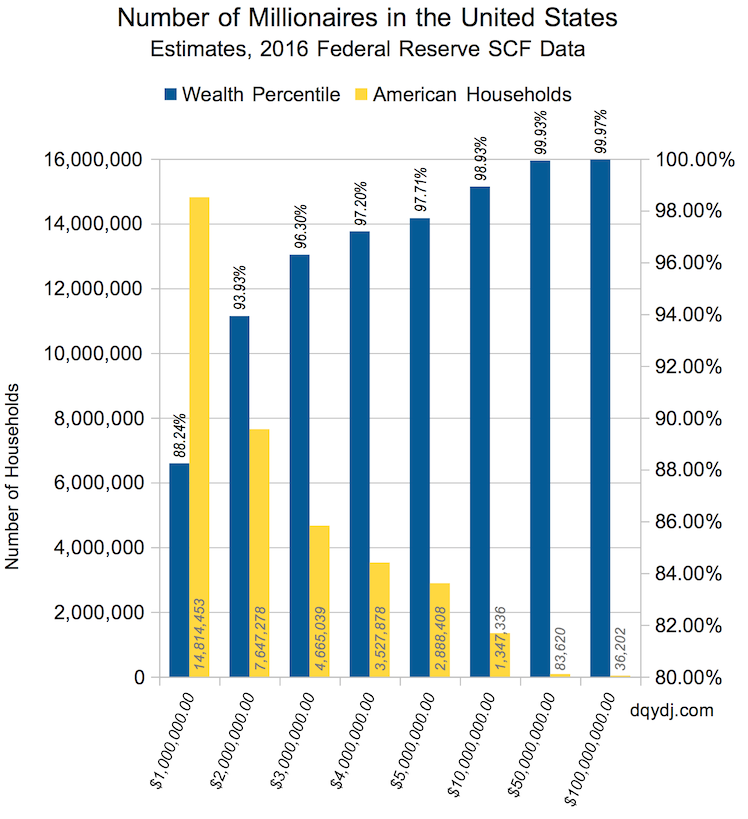
We can actually look at the Fed's Survey of Consumer Finances and get a reasonable number here. Household's with >$50m are top 0.07% percentile and there are approximately 84k of them out of around 130 million households....
[1] https://cdn.dqydj.com/wp-content/uploads/2017/09/millionaire...
tjpd
|
5 years ago
|
on: Modeling a Wealth Tax
I'm not a fan of this proposal but I think this line of argument is pretty flimsy and pretty specious.
In the Bay Area you're already subject to a form of wealth tax called property tax. And it's substantial. If you live in San Francisco you'll get charged 1.1801% every year [1] on the value of your wealth (property). If I bought a house in SF and live for another 60 years I would be taxed 60 times on that same asset. Does that mean the government will over the course of my life take 33.6% of my house?
It's not as if property tax has kept a damper on Bay Area house price inflation.
[1] https://sftreasurer.org/property/understanding-property-tax
tjpd
|
6 years ago
|
on: Everything I know about Kubernetes I learned from a cluster of Raspberry Pis
I can also recommend MagicSandbox (
https://www.msb.com/) which provides a lot of learning content alongside a real k8s remote environment.
tjpd
|
8 years ago
|
on: GitHub shouldn't allow username reuse
Isn’t this the developer’s or Go’s security issue first before it’s a GH facepalm? GH doesn’t make any representations about the provenance or the safety of the code on their site. It is the user and toolchain that’s making those potentially dangerous assumption, no? Doesn’t blocking id reuse open them up to a kind of ID squatting and DOS?
tjpd
|
8 years ago
|
on: 500 Startups still owes money to its latest group of startups
"While we were completing legal documentation related to Dave McClure's resignation from 500, funding for certain companies was delayed. Since then, we have resumed fundraising, as well as funding our investment commitments. We have been regularly communicating with our companies regarding the status of their investment and expect to complete all outstanding investments in December."
Here's my outsider's guess: Dave was almost certainly a Key Person in 500's Limited Partnership Agreement. When a Key Person leaves, for whatever reason, that triggers a Suspension Event and the start of the Suspension Period. During the suspension period, the LPs are not required to contribute capital except for certain things (e.g. management fees, follow-ons). The LP's (some threshold or some combination of them like the LP advisory committee) then have 60-90 days to vote whether or not to continue with the fund.
500 would already have called down some capital so that meant they could make a few investments but otherwise, during the suspension period they likely couldn't make any new ones. Since then they got their LPs on board with the idea of continuing without Dave and now can fulfill all their obligations. That would make sense to me because 500 as an institution is much more than just one man.
tjpd
|
8 years ago
|
on: Disney will pull its movies from Netflix and start its own streaming services
Disney has a very, very large catalogue of content but is particularly strong on kid's content. It will be very high up on the list for the average household, and a lot of consumers
tjpd
|
8 years ago
|
on: Reddit raises $200M at a $1.8B valuation
>> The company has about 230 employees, up from around 140 at the beginning of the year. Huffman would like to end 2017 with around 300 full-time staff.
> That sounds odd too me as well, maybe I am not versed in startup culture. Having a goal of going from 230 to 300 people seems like a pointless metric (and wasteful). It's like saying "I want to write 1000 lines of code today".
I understand this criticism but I think the intent behind their statement is different from the intent you're reading into it.
It sounds like you think they're using it as some kind of empire building management metric (I might be wrong). ie. 300 people and well be a great company! As you say that'd be pretty stupid and so I doubt that. Here's my guess: the headcount number is by product of a broader growth plan. ie. We need to get to X revenues, or scale to X users, or build Y products in Z months which means we need to hire X engineers, Y marketers, Z salespeople in a certain time frame.. add all that up and that means we need 300 people by the end of 2017.
The reason it gets boiled down to 300 is two-fold: 1) It's just hard to get a journalist to be interested in that kind of considered detail & much easier for journalists to remember that one number 2) It's actually still a good signal in an ultra-competitive hiring market. ("you bet we're hiring!, we have lot's of jobs openings! didn't you here we're looking for 100's of people, come and help build that site that you already spend half day on")
300 as a management metric = no sense;
300 as by product of growth plan, headline grabbing takeaway, beacon to potential talent = better.
tjpd
|
8 years ago
|
on: Chicago taxi industry sliding towards collapse
There are plenty of examples of individual companies (or groups of companies) getting too much monopolistic (or oligopolistic) power and doing just that or similar. You could look at at the Phoebus Cartel of lightbulb manufactures [1], the Bell System monopoly [2], or in transportation the GM Streetcar conspiracy [3].
Due to Uber's network effects you could say they'd have even greater power to change prices dramatically. Let's say Uber became the dominant transportation network in a particular geography and then trebled prices. Any new competitor has to both lure riders and drivers from Uber. Riders, sure they can be lured by cheaper travel but drivers want to earn the most money. Uber could simply double how much they paid drivers. All the existing drivers (and any new drivers) would rather work for Uber and get paid more. In fact they would have a vested interest in seeing the competitor fail.
1: https://en.wikipedia.org/wiki/Phoebus_cartel
2: https://en.wikipedia.org/wiki/Bell_System#Nationwide_monopol...
3: https://en.wikipedia.org/wiki/General_Motors_streetcar_consp...
tjpd
|
9 years ago
|
on: Ask HN: Where should I host my startup?
No it's not, it's really not. In fact I think in a niche market then it's often even more true.
If you're building in a niche then (almost by definition) you're not going to need a lot of infrastructure. There won't be millions of customers and they (usually) won't need tons of infrastructure.
I think the only case is where you're building a business like Pinboard :) Where the CLTV is relatively low but the the bandwidth, storage & compute is relatively high.
Regardless of the market you're in though, if you want to build an independent livelihood or a lifestyle business typically infrastructure costs still shouldn't be a factor.
A good livelihood might be $50k/yr say or $4k/mo roughly. The difference between $5/mo and $500/mo in hosting costs isn't what determines success or failure. It's whether or not you've built, marketed and sold an app to 5 or 500 customers.
tjpd
|
9 years ago
|
on: Ask HN: Where should I host my startup?
I disagree with this wholeheartedly and just posted why above but wanted to reiterate it here. This might just have been a throw-away comment but "bloat", lock-in & cost are red-herrings.
"Bloat" here is a virtue. Heroku removes two levels of drudgery and administration between you and the hardware. Who wants to be racking hardware? Who wants to be patching the OS? Who wants to be dealing with package vulnerabilities? None of this helps actually build the business
Lock-in is minimal, particularly if it's a self contained app and you're not using a lot of services. There are countless examples of companies who've moved off of Heroku when they've gotten big. Plus there's also lock-in using EC2, S3, AWS. There's lock-in of some level regardless where you run your stuff.
Future cost is also really, very very low because P(success) is, sadly, super low.
tjpd
|
9 years ago
|
on: Ask HN: Where should I host my startup?
Reading a lot of these comments make me think that everyone on HN is a cynic of the Oscar Wilde/Lady Windermere variety: "A man who knows the price of everything and the value of nothing" [1].
IMHO you should go with Heroku and ignore anyone who's suggesting dedicated servers, VPSes, AWS, Docker or containers. Every moment you spend maintaining a server or doing devops is wasted because it's time not spent building or marketing your _app_.
New startups' biggest expense is founders' time. It seems a lot of people, even on HN, don't realise it because it's a hidden cost. But if you think that a decent developer is worth at least $50/hr and it might take you an 1hr to set up and 1hr/yr to manage a server (e.g. apply patches, update security) then you're better off not spending those 2hrs and paying an extra $100 hosting your app.
Worrying about the future infrastructure cost is also wrong-headed. It's a kind of premature optimisation. To get the real, expected future cost, the projected infrastructure cost has to be multiplied by the probability that you'll actually get big, which for start-ups, is very low.
[1]: http://www.gutenberg.org/files/790/790-h/790-h.htm
tjpd
|
9 years ago
|
on: New Snowden leaks unravel mystery behind NSA's UK base
One of the interesting things from the slide shown in the article is that they're extracting the azimuth and elevation of roof based satellite dishes from aerial imagery presumably to cross correlate with the satellite orbits and whatever comms they're eavesdropping on.
tjpd
|
9 years ago
|
on: Hyperloop One’s co-founder is suing the company and other executives
Wow, those are some pretty outrageous allegations if true:
  > Defendant Shervin Pishevar, who was generally uninvolved in
  > day-to-day matters, began dating the company’s PR vendor, and
  > increased her salary from $15,000 to $40,000 a month ...

  > When their subsequent wedding engagement fell through, he
  > finally heeded suggestions that her work was worth little,
  > and terminated the arrangement.

  > Similarly, Defendant Joseph Lonsdale insisted that the
  > company hire his little brother’s two-person outfit, with
  > no notable experience with companies building hardware and
  > engaged in infrastructure development, and few independent
  > contacts with international and top-tier investor funds,
  > as the company’s exclusive  investment bank

  > Meanwhile, Shervin installed his brother, a personal injury
  > and criminal defense attorney with his own small firm in
  > Rockville, Maryland, as Hyperloop One’s General Counsel,
  > granting him salary and stock options far greater than even
  > the most talented engineers received.

  > Later that night, Afshin Pishevar, the lawyer and Shervin’s
  > brother as mentioned in the letter, was seen placing a noose
  > on BamBrogan’s chair on the security camera.