
yyy888sss | 1 year ago | on: Australia must treat housing as a human right: Former State Supreme Court judge
yyy888sss's comments
yyy888sss | 1 year ago | on: The UK can go back to being the richest country in the world
They should try catching up to their European neighbours first:
https://media.licdn.com/dms/image/D4D22AQFfh_jg66bW1A/feedsh...
yyy888sss | 1 year ago | on: The EU should be the heat-pump pioneer
Pioneer? Nearly every home in the US already uses heat-pumps: https://ourworldindata.org/grapher/technology-adoption-by-ho...
In cold climates many people still use gas heating because its cheaper, making electricity cheaper would be the only realistic way to increase heat-pump usage in winter.
yyy888sss | 2 years ago | on: Japan's Nikkei surpasses 1989 all-time high
Price of gold in 1989: ~2000 yen/g
Price of gold in 2024: 9,800 yen/g
yyy888sss | 3 years ago | on: Analysis finds Australia’s inflation being driven by company profits, not wages
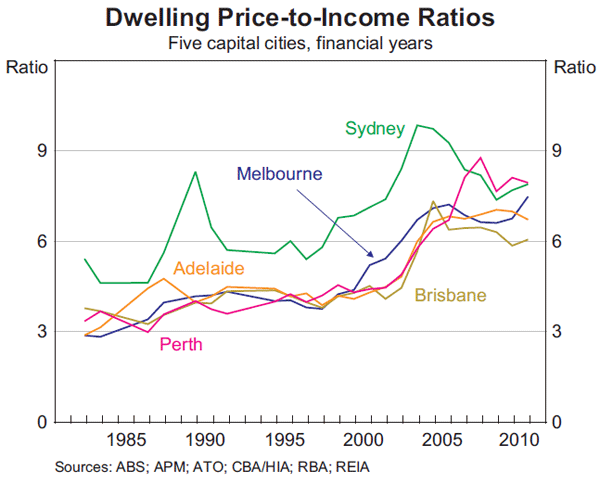
Inflation is a monetary phenomenon. Prices are rising in Australia because the Central Bank created $450billion out of thin air during the pandemic [1]. The bank has persistently kept interest rates low, creating a massive housing bubble [2]. For everyone saying there was 'low' inflation in the 2000s despite cheap money, remember that China and Asia were rabidly growing, flooding the world with cheap manufactured goods and lowering real prices (often 10x reduction). The inflation can still be seen when looking the price of Australian real estate, or stock markets such as Nasdaq. As for this article, companies would always like to increase prices and profit. They can only do so in unison if there is suddenly more money sloshing around.
[1] - https://www.rba.gov.au/chart-pack/central-bank-balance-sheet... [2] - https://www.rba.gov.au/publications/bulletin/2012/dec/images...
yyy888sss | 3 years ago | on: UK pensions hit with margin calls as gilts and sterling slide
Heres what happened: The Bank of England (BoE) suppressed interest rates for 2 decades, driving government bonds from 6% to 2%. Pension funds typically had a high percentage of bonds, so they decided to borrow money (again, made artificially cheap by the BoE) to buy 2-3x the amount of bonds on leverage to be able to pay out the same as one 6% bond. Now the BoE is slowly raising rates to 'fight' the inflation it created over the past 20 years, which is causing these house of cards pension funds to start to tremble. The fund directors are relaxed though as have already paid themselves large bonuses every year, and after 2008 they realised they could rely on the government to come in and socialise the loses stemming from their financial recklessness.
yyy888sss | 3 years ago | on: New insignia for Air Domain Intelligence has a UFO
It could of course be the AvroCar [1]. Although in this case they are referring to 'UFOs', there have been multiple experimental aircraft that look exactly like flying saucers.
[1] - https://en.wikipedia.org/wiki/Avro_Canada_VZ-9_Avrocar
yyy888sss | 3 years ago | on: No, YouTube, I will not subscribe to Premium
Youtube premium is the best value video subscription there is and its a win-win: You can a clean ad-free experience and both Youtube and the video creator get more revenue.
yyy888sss | 3 years ago | on: MIT invents $4 solar desalination device
Modern desalination plants produce at less than $1 per cubic meter, thats $0.001 per litre...
yyy888sss | 3 years ago | on: How Inflation Works
Yep, innovation means prices understate the true level of inflation. Eg: If technology reduces costs by 5% and the CPI measures 2%, then the real rate of inflation is at least 7%.
yyy888sss | 3 years ago | on: How Inflation Works
Defining inflation as rising prices is the newer, MORE narrow definition as measurements such as CPI are capturing the downstream effects of a fundamental cause (creating money).
yyy888sss | 3 years ago | on: Construction is life
Very true, as construction is not just new builds but also renovation and maintenance. Even a theoretical city with completely stable population still needs to keep its structures up to date and renew infrastructure.
yyy888sss | 3 years ago | on: How Inflation Works
Inflation is the expansion of the money supply (eg by money printing). A long term rise in prices (houses, stocks, CPI) is the consequence of inflation, just as a rising water level in a lake is the result of rain. The global economy is like a lake with growing capacity, so prices UNDERSTATE the true rate of inflation.
yyy888sss | 3 years ago | on: Show HN: A central bank simulator game with a realistic economic model
In reality of course central plannners 'pulling levers' and setting prices never works. The interest rate is one of the most important prices of them all, which is why having the government meddle with it has proven so destructive.
yyy888sss | 3 years ago | on: Inflation is differential and restructuring (2021)
Inflation is an expansion in the money supply, such as new discoveries of gold or or printing paper money or creating credit. A baker would say he will 'raise' or 'lower' the price of his bread, not 'inflate' it. Defining inflation by the CPI or a similar measure is like defining the rain as a "increase in height of a river". It is the rain that CAUSES the rise in the river, and inflation CAUSES a general rise in prices.
yyy888sss | 3 years ago | on: Neoliberalism has resulted in preference for greater income inequality
But the 'neo' refers to the resurgence of basic ideas of freedom, not a big change in philosophy over the original liberal ideas.
yyy888sss | 3 years ago | on: Neoliberalism has resulted in preference for greater income inequality
Freedom to do whatever you want as long as it does not infringe the rights/freedoms of anyone else.
yyy888sss | 3 years ago | on: Neoliberalism has resulted in preference for greater income inequality
Liberalism means freedom in all spheres (including economically and socially), no need to add the neo- prefix. When you have freedom in a global economy there will be massive income inequality (think about Lebron James or Elon Musk vs the average person) but everyone is better off. Technology allows the best athletes to entertain millions, and the best entrepreneurs to serve billions.
yyy888sss | 4 years ago | on: Architect Resigns in Protest over UCSB Mega-Dorm
For $1.5 Billion, why don't they just build 1000 luxury 5 bedroom mansions? If they had the land area, they could even build 5000 individual detached homes for that budget. They could even splurge and give each bedroom a window!
yyy888sss | 4 years ago | on: Global Climate Report – September 2021
In my town most of the upper income people live outside the city in houses with rainwater collection, septic tanks and increasingly no electric grid connection either (thanks to solar panels and battery). There is nothing self sufficient about this. Every one of these households still has 2 cars, fridge, tv, internet, computers, supermarket food, medicine, clothes and furniture from China etc. Most people who go off grid in developed countries probably consume more resources than the average city dweller living in a small apartment.
page 1
Right now in Australia we have tyranny of the majority, because the 30% of home owners + 30% of mortgage holders have realised they can get rich if the government restricts supply (bans development) and increases demand (adjusts immigration yearly to outpace construction). For a century there seemed to be a 'social contract' that getting young people a home and helping them start families was important for the country, now though that concept seems to be totally dead.
Just creating a legal 'right' to build a house on your land would be the best fix and help a lot, but long term we really need to fix the social contract which held everything together in the first place.